
A side photo, and suddenly your nose looks bigger than you remember. Chin filler at Dr Joney De Souza Clinic in Marylebone brings your chin forward so nose, lips and jaw fall into balance.
You catch your reflection in the side mirror of a lift, or a friend shares a photo taken from the side, and suddenly your nose seems bigger than you remember. Chin filler at Dr Joney De Souza Clinic in Marylebone answers that moment by bringing your chin forward a few millimetres.
| Performed by | Results | Downtime | Your plan |
|---|---|---|---|
| Dr Joney De Souza or Dr Mattia Parducci | Visible straight away, settled within two weeks | Swelling eases over two to three days | Set by the doctor at consultation |
It is a small change with strong evidence behind it. In a controlled trial of 192 adults with a receding chin, investigators who examined patients in person rated 91.8 percent of the treated group as improved at six months. The benefit was still evident at twelve months.
The chin is rarely the feature people think they dislike. A receding chin makes the nose look longer, pushes the lips visually forward and lets the jaw slope softly into the neck. Bring the chin forward and the nose settles, the lips fall into line, and the jaw finds its edge again.
Chin augmentation is one of the approved uses for dermal fillers listed by the US Food and Drug Administration, alongside the lips and cheeks. The trial above tested a hyaluronic acid filler for chin retrusion against an untreated control group. Few aesthetic treatments have been measured that carefully.
Photographs told a more cautious story than live examination. On photo review, 56.3 percent of the treated group were rated as improved at six months. Patients rated themselves too. On the FACE-Q questionnaire, satisfaction with the chin rose by an average of 35.6 points, reaching 71.3 out of 100 at six months.
The live figure matters because a profile is three-dimensional. A flat photograph loses some of the projection that is obvious when you turn your head across a room. That is also why the doctors here judge a chin face to face and from the side, rather than from a single front-on picture.

Faces are read as a set of relationships, not as separate features. When one point of the profile sits back, every point around it looks slightly out of scale. The eye settles on whatever stands furthest forward, so with a receding chin the nose and lips take the attention.
A weak chin also changes the neck. When the chin sits back, the angle between the jaw and the throat opens and softens. The neck looks shorter and fuller in photographs, even on a slim frame. Bringing the chin forward closes that angle, so the lower face reads cleaner from the side without any filler along the jaw.
Faces are read as a set of relationships, not as separate features.
Some chins are small by nature and have looked that way since the teenage years. Others look less defined with time as the soft tissue around them changes. Both respond to the same principle, projection placed where the chin would naturally sit, so the result looks inherited rather than added.
Your appointment begins with your profile, not your face straight on. Dr Joney De Souza (GMC 7008632) or Dr Mattia Parducci (GMC 7635663) looks at you from the side while you sit upright with your head level. From the front, a receding chin often looks perfectly ordinary.
One reference is the Ricketts line, drawn from the tip of the nose to the front of the chin. A 2024 paper in Plastic and Reconstructive Surgery Global Open describes it as ideally connecting those two points, with the lips sitting behind it. When the chin falls well short of the line, the lips look prominent and the nose looks long.
The doctors think about height and width as well as projection. Some chins need to come forward, some need a touch more length, and some need a little width to suit a broader jaw. A chin brought forward without enough height tends to look pointed. The shape is therefore planned in all three directions before a gel is chosen.
Movement is checked too. You are asked to smile, speak and close your lips gently, and the doctor watches how the chin moves. A chin that puckers into a dimpled, orange-peel surface as you talk is noted, because anti-wrinkle injections soften that dimpling and can join the plan.
Older photographs help when you feel your chin has changed rather than always being small. The plan then follows your own bone structure, with the nose, lips and jaw treated as one picture. Bring two or three pictures from different years, ideally one taken from the side. They show the doctors where your chin used to sit and how far to go.
Men and women are planned differently too. A man’s chin is usually built squarer and a little broader, to line up with a strong jaw angle. A woman’s chin more often suits a softer, slightly narrower point. In both cases the aim is the chin your face would have carried anyway.
The clinic chooses the product for each area, and the chin calls for a gel with enough body to hold a shape against the bone. Placed deep at the point of the chin, it carries the soft tissue forward and gives light a clear place to land. From the side, that small new highlight is what the eye reads as a defined chin.
The effect on the nose surprises most people. Nothing is done to the nose itself, yet once the chin comes forward it looks smaller, because it is no longer the furthest point of the profile. Where the bridge has a bump of its own, non-surgical nose reshaping can be planned alongside the chin.
The lips settle in the same way. Lips that seemed too full in profile often look right once the chin meets them, and the urge to add volume fades. If the lips themselves have thinned, the doctors plan lip filler as a separate, later step, once the chin has set the proportions.
Chin filler builds projection and shape. It does not tighten loose skin under the chin or lift a jawline that has softened through laxity. Adding more gel to the chin will not fix either. That work belongs to skin tightening, which treats the skin itself.
The clinic’s own dermal filler guidance says the same. Where loose, crepey skin is the main issue, filler is not the right tool, and you are pointed to a better one. The sagging jawline guide shows how those treatments sit beside filler when a profile needs both.
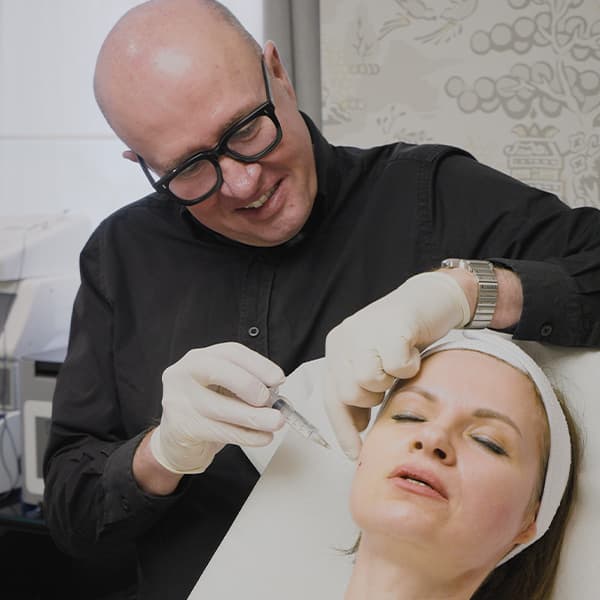
A chin filler appointment takes 30 to 45 minutes in all. Numbing cream goes on first and takes about 20 minutes to work. The point and height of the chin are then marked with a white pencil while you sit upright. Your plan is drawn on your face before any gel goes in.
The gel is placed with a fine needle or a cannula. Most people describe a firm, deep pressure rather than anything sharp. Between placements you are handed a mirror and shown your profile, so you watch the balance arrive a little at a time.
The change is visible as you sit up, and it refines over one to two weeks as early swelling settles and the gel integrates. Mild tenderness, redness or small marks usually settle within one to three days. The chin you see in a photograph a fortnight later is the true result.
You can go back to your desk the same day. Strenuous exercise waits 24 hours, and saunas, steam rooms and hot yoga wait 48. SPF goes on as usual from the following morning. Results last six to eighteen months depending on the product and the area. Hyaluronic acid can also be dissolved with hyaluronidase if you ever want the shape changed.
Your first visit is with Dr Joney De Souza or Dr Mattia Parducci on Blandford Street, a short walk from Baker Street and Bond Street stations. They look at your profile from both sides, feel the chin and jaw, and take photographs from the angle that first caught your eye.
The medical questions come before any marking. Are you pregnant or breastfeeding? Have you had filler or any other treatment in the chin or jaw before? Are you on blood-thinning medicine? Pregnancy and breastfeeding mean treatment waits, and earlier filler changes how much new gel the chin needs.
Most people reach a balanced profile in a single session, sometimes with a small refinement a few weeks later. The consultation gives the real answer, because a naturally small chin and one that has lost definition need different amounts. Your plan and its investment are set out before anything begins.
The clinic sits in Marylebone, close to Harley Street, and patients come from Fitzrovia, St John’s Wood and across central London. Patients have given the clinic a 4.9 rating on Google across more than 270 reviews. You can meet both doctors on the meet the team page. Everything else about the treatment is on the dermal fillers page.
Short clips filmed at Dr Joney De Souza Clinic in Marylebone, so you can see how dermal fillers is carried out before you book.
If your chin has been unbalancing your profile, Dr Joney De Souza or Dr Mattia Parducci will study it from the side and show you how little it takes to bring nose, lips and jaw into proportion. Ring 020 7043 0748, or message the clinic on WhatsApp to arrange your visit.
From whether chin filler makes a face look longer to what it does for the nose, these are the questions people ask about their profile before treatment. Where an answer gives a figure, the study is linked.
Only if length is what your face needs. Projection, height and width are planned separately for every chin. A short lower face gains a little length, while a face that is already long gains forward projection alone. The goal is a lower third that matches the rest of your face, so it reads as balanced rather than simply longer.
In profile, very often yes, even though nobody touches the nose. The eye judges size by comparison, so a nose standing well forward of a small chin looks larger than it really is. Once the chin comes forward to meet it, the nose sits inside a more even line. From the side it then reads as smaller and neater.
Take a photograph of yourself from the side with your head level and your lips gently closed. If your lower lip sits clearly forward of your chin, the chin is probably set back. A chin that seems to slope back into the neck tells the same story. Seeing you in person confirms it, because posture and camera angle both change the picture.
It does. The gel sits deep, beneath the muscles that move as you speak, so your chin keeps its new shape while your mouth moves freely. There is no visible edge for anyone to spot once the early swelling has gone. What people notice is a profile that looks more settled every time you turn your head.
Most people find it more comfortable than they expected. Numbing cream goes on first for about 20 minutes, and placement feels like a deep, steady pressure rather than a sting. The chin can be tender to the touch for a few days, rather like a light bruise. After that it simply feels like your own face again.
For most profiles the chin comes first, because a chin set in the right place changes how full the lips look from the side. Plenty of people decide they no longer want extra lip volume once it is done. If the lips still look thin after the chin has settled, gentle lip work follows as a separate, later step.
Yes. Hyaluronic acid gel breaks down with an enzyme called hyaluronidase, and the doctors use it to soften or remove filler where it is needed. That reversibility is one reason hyaluronic acid suits a first change to the profile. You live with the new shape on your own face before deciding to keep it for the long term.
For many people it is a way to see a stronger profile without surgery or a permanent change. In a controlled trial of hyaluronic acid chin filler, the benefit was still evident at twelve months. The shape can be refined, or allowed to fade if you prefer. Dr Joney or Dr Mattia will tell you whether filler suits the projection your chin needs.
Yes, and the shape is tailored to the face. Men often want a squarer, broader chin that lines up with a strong jaw angle. Women more often prefer a softer, slightly narrower point. The gel and the placement are adjusted to suit, and the result holds up under stubble or a full beard as well as on clean-shaven skin.
It sharpens it. As the chin comes forward, the soft slope from chin to throat becomes a clearer angle in side photographs, and the neck looks longer. Where fullness under the chin comes from loose skin, the clinic’s skin tightening treatments work alongside filler. Together they give the cleanest line in profile.
