
A friend shares a laughing photo and your eye goes straight to the fans beside your eyes. Crow’s feet treatment in Marylebone softens them and keeps the smile in your eyes.
Someone shares a photograph from a birthday dinner, you are laughing in it, and your eye goes straight to the fine fans at the outer corners of your eyes. Concealer only makes them more obvious, because by lunchtime it has gathered in the creases. Crow’s feet treatment at Dr Joney De Souza Clinic in Marylebone softens the lines while the warmth of your smile stays exactly where it belongs.
| Performed by | Appointment | Downtime | Results |
|---|---|---|---|
| Dr Joney De Souza or Dr Mattia Parducci | About 15 minutes | None, straight back to your day | Begin in three to five days, settle at two weeks |
Those fans start far earlier than most people think. When researchers photographed 184 adults aged 18 to 24 as they smiled and squinted, the commonest pattern beside the eye was radial lines running from the outer corner to the brow tail. They showed in 34.8 percent of the group, years before anyone thinks of treatment.
The skill lies in where the doses go. The muscle that crinkles the outer eye is a ring, and only its outer rim draws the fan. Tiny amounts placed along that edge relax the crinkle, while the rest of the ring carries on lifting your cheeks when you laugh. Dr Joney De Souza (GMC 7008632) or Dr Mattia Parducci (GMC 7635663) performs every treatment.
The orbicularis oculi wraps around each eye like a soft circle of fibres. It closes the lids when you blink and squeezes the outer corners when you smile, squint into sunlight or laugh at a friend. Each squeeze folds the thin skin beside the eye into small pleats that radiate outward towards the temple.
In your twenties those pleats vanish the moment your face relaxes. Over the years the skin there thins and loses some of its spring. The pleats then linger a little longer after each smile. One day they are visible in a neutral expression too, particularly under the flat light of a bathroom mirror.
Photographs are harsher than mirrors because the camera catches you mid-laugh. Flash and bright daylight throw a fine shadow into every crease, so the fan looks deeper than it feels to the touch. Many people book crow’s feet treatment in London after a wedding album or a holiday picture, rather than after anything they saw at home.

In 2003 the New York plastic surgeon Michael Kane published a classification of crow’s feet patterns in Plastic and Reconstructive Surgery. He described several distinct patterns of movement at the outer eye. Treatment, he concluded, should follow the pattern in front of the injector rather than a fixed template.
You can see the differences in any group photograph. Some fans spread across the whole outer corner, from the upper lid down to the cheekbone. Others sit mostly below the eye and crease the top of the cheek. A smaller number gather high near the brow or stay tight around the corner itself.
Dr Joney De Souza or Dr Mattia Parducci asks you to smile broadly, then squint, then relax. They watch where the lines start and how far they travel towards the hairline. The points along the outer edge of each eye are marked from that movement. The two sides of a face rarely match, so each eye gets its own map.
A real smile involves the eyes as well as the mouth, and the softening at the cheek is part of what makes it read as warm. That is why the doses for crow’s feet are small and placed with care. The aim is to calm the outermost fibres that fold the skin, rather than switching off the whole ring.
When it is done well, you smile in the mirror a fortnight later and see an expression that is clearly yours. The eyes still crease a little at the corners, which keeps the face friendly and open. What has gone is the dense web of pleats that made you look tired even on days you felt bright.
There is a welcome side effect for anyone who squints at screens or into bright sun. Once the outer eye relaxes, that habitual narrowing becomes softer too. People often say their face looks more open in the afternoon, when tiredness used to pull the corners tight and leave them looking strained.
The evidence for treating this area is strong. A 2014 multicentre trial in Dermatologic Surgery randomised 445 adults with crow’s feet to the treatment or a placebo. After thirty days, investigators rated the lines at full smile as none or mild in 66.7 percent of the treated group. On placebo the figure was 6.7 percent.
People often say their face looks more open in the afternoon, when tiredness used to pull the corners tight and leave them looking strained.
The people in the trial judged their own faces as well. In the treated group 58.1 percent rated their lines as none or mild at maximum smile, compared with 5.4 percent on placebo. Lines at rest improved too, which matters for the faint etching that shows in a neutral face under bathroom lighting.
Those figures come from one standard dose given in a research setting. At the clinic the dose follows your own pattern and the strength of your muscle. A narrow fan and a wide one are treated differently. The review at two to three weeks confirms that both eyes have settled evenly.
Doctors describe crow’s feet in two ways. Dynamic lines appear only when you smile or squint, and they respond well to anti-wrinkle injections alone. Static lines are faintly etched into the skin even when your face is still, because years of folding have left a mark in the surface itself.
Static lines still soften with treatment, since less folding gives the skin a chance to recover. Anti-wrinkle injections relax muscle, though, and they do not thicken thin, crepey skin beneath the eye. Polynucleotides do that work, signalling the skin’s repair cells over a course of two or three sessions.
For a tired under-eye, Lumieyes is another option the doctors raise, and our guide to fine lines shows how the combinations come together. If Dr Joney believes another approach would suit your eyes better, he will tell you before anything is booked.
Anti-wrinkle injections are a prescription-only medicine, so treatment follows a face-to-face assessment with a doctor. Your first visit is with Dr Joney De Souza, founder and Medical Director, or Dr Mattia Parducci. Both are on the GMC register, and either one holds the needle on the day.
Before any dose is drawn up, you are asked when you last had anti-wrinkle injections and where, whether you are pregnant or breastfeeding, and which medicines you take. You are also asked whether there is a wedding, a trip or a photograph you are planning around. The answers shape the dose and the date.
A recent treatment elsewhere changes the starting point, so the doctors want to know what was used and when. An event three weeks away fits neatly, since the softening settles at about two weeks. A face that has never been treated usually starts with a lighter dose, with the review showing whether the next round needs more.
The skin beside the eye is thin, so the needle used is very fine. Most people describe each injection as a quick sting, a little like a single plucked hair. There are only a few points on each side, and the injecting is over in minutes, with no numbing cream needed.
A tiny raised bead sits at each point for a few minutes and flattens on its own as the treatment disperses into the muscle. A small pinprick of redness can linger for an hour or so. Mineral make-up covers it easily if you are heading back to the office.
Leave the area untouched for the rest of the day, skip the gym and stay upright for a few hours. Around day three to five you smile and feel the corners crinkle less. The softening settles fully at about two weeks, and your review appointment checks that both eyes match.
Results last around three to four months. Even as the effect wears off, the skin beside the eye has spent months folding less, and it tends to look smoother than before you started. Regular treatment keeps the lines quieter between appointments.
Crow’s feet rarely appear alone. Most people who notice them also see horizontal lines across the forehead or the two vertical frown lines between the brows. Treating the upper face as a whole keeps your expression balanced, so the eyes never look more relaxed than the brow above them.
Dr Joney De Souza or Dr Mattia Parducci will tell you whether softening all three gives a more even, rested upper face. The plan and its investment are set out at the first visit, and every area is described on our anti-wrinkle injections page.
Starting early has its own appeal. Softening the crinkle while the lines are still dynamic means the skin spends fewer years being folded into the same pleats. Our piece on prevention and correction explores that idea across the whole face.
Your first appointment is with Dr Joney De Souza or Dr Mattia Parducci at our clinic in Marylebone, near Regent’s Park. They study your smile, your squint and your face at rest, go through your medical history, and agree the dose with you before anything is injected.
Most people treat crow’s feet three or four times a year to keep the effect even. Some find they can stretch the gap after the first few rounds, and the consultation gives the real answer for your skin. Treatment can usually go ahead on the same day once you are happy with the plan.
The clinic sits moments from Harley Street and is an easy trip from Mayfair or anywhere in central London. More than 270 Google reviewers give the clinic an average of 4.9. If your smile lines have started to show up in every photo, come and let the doctors see them. You keep the laugh that makes the photo yours.
Short clips filmed at Dr Joney De Souza Clinic in Marylebone, so you can see how anti-wrinkle injections is carried out before you book.
If crow’s feet are the first thing you notice in photographs, come and meet Dr Joney De Souza or Dr Mattia Parducci in Marylebone. Call us on 020 7043 0748, or message the team on WhatsApp to arrange a visit.
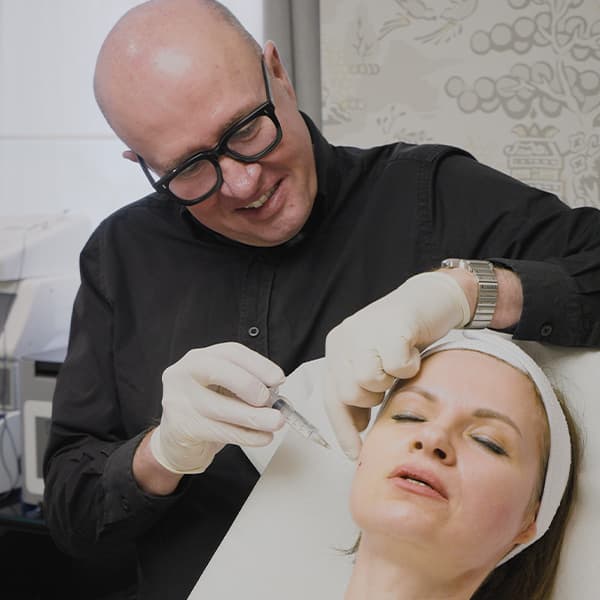
Here are the things people ask most before softening the lines around their eyes, covering make-up, timing, age and what happens to the lines once the treatment wears off.
Usually only a handful on each side, set in a gentle arc along the outer edge of the eye. The exact number depends on how far your lines spread and whether they sit high near the brow or low across the cheek. Wider fans need a few more points, each carrying a very small dose.
No. Your smile is powered mainly by the muscles around your mouth and cheeks, and those are not touched. The doses only relax the outer fibres of the eye muscle, so your eyes still soften and crease slightly when you laugh. Friends see the same smile, with fewer lines framing it.
You can, though it is kinder to wait until the evening or the next morning. Applying eyeshadow or eyeliner means pressing and rubbing near the injection points, which is best avoided for the first few hours. A light dab of concealer over any small red mark is perfectly fine straight away.
Expect roughly three to four months of smoother corners. The effect fades gradually, so the crinkle returns slowly rather than overnight. Booking your next appointment as the movement starts to come back keeps the corners smooth all year. Some people find the gaps lengthen with regular treatment.
There is no fixed age. A 2025 study of adults aged 18 to 24 found fan-shaped movement lines at the outer eye in about a third of them, so early lines are normal. Some people start with a light dose in their late twenties once the lines linger, while others first come in their forties or fifties.
Cameras catch you mid-laugh, when the muscle is folding the skin hardest, and flash or strong daylight drops a shadow into every crease. In the mirror you usually look at a relaxed face in softer light. Treatment helps most in exactly those caught moments, which is why photographs often show the difference first.
No, they return to how they were before, and often look a little softer. While the muscle was relaxed, the skin spent months folding less often, which gives it a rest. Stopping treatment simply lets your normal movement resume at its usual pace, with no rebound effect.
Yes, and many people prefer it. A 2018 phase 3 trial of 787 adults treated the forehead and frown lines with or without the crow’s feet in the same sitting. Treating both keeps the upper face in balance, and the appointment still takes only around fifteen minutes in the chair.
Often, yes. The outer fibres of the orbicularis oculi muscle also bunch the skin of the upper cheek when you smile. Relaxing them tends to smooth the fine folds just below the outer eye. Creasing from thin or crepey skin under the eye responds better to skin quality treatments. Dr Joney De Souza will say which route suits your skin.
Wait until the following day before running, lifting or hot yoga. Raising your heart rate and blood flow in the first hours can move the treatment away from where it was placed. A gentle walk home through Marylebone is perfectly fine, and the next morning you can return to your usual training.
