
Colleagues keep asking if you are alright while you read an email. Downturned mouth treatment in Marylebone finds the muscle pulling your corners down and lets your face rest kindly.
A colleague leans across the desk and asks whether everything is alright, and you realise you were simply reading an email. It keeps happening. Your mouth has started to rest with its corners turned slightly down, so your quiet face now reads as disappointed or sad. Downturned mouth treatment with anti-wrinkle injections at Dr Joney De Souza Clinic in Marylebone is built for that resting expression.
| Performed by | Appointment | Downtime | Results |
|---|---|---|---|
| Dr Joney De Souza or Dr Mattia Parducci | About 15 minutes | None, straight back to your day | Begin in three to five days, settle at two weeks |
A small muscle on each side of the chin does the downward tugging. Relax it, and the muscles that lift your smile no longer have to fight it. Dr Joney De Souza or Dr Mattia Parducci places each dose.
The skill is in finding that muscle, because it rarely sits where the textbooks put it. When doctors scanned 290 people by ultrasound before treating downturned corners, the muscle lined up with the classic landmark in only 20.2 percent of them. In the other 79.8 percent it sat 2 to 5 mm further out.
Its name is the depressor anguli oris, usually shortened to DAO. It is a thin, triangular muscle that starts along the edge of your jawbone, a little to the side of the chin. From there it fans upwards and narrows to attach right at the corner of the mouth.
When the DAO contracts, it draws the corner of the mouth down and slightly outwards. That is the movement you make when you grimace, pout in disapproval or try not to cry. The study authors describe it as a key muscle in expressing sadness, and most of us use it far more than we realise.
Above the corner, a group of lifting muscles does the opposite job, pulling your mouth upwards and outwards whenever you smile. For years the two sides stay balanced. As the skin loses some firmness, the downward pull starts to win even when your face is completely at rest.
Small folds then form beneath each corner. They extend towards the chin as what people call marionette lines, which deepen the downturned look further. Under a ceiling light they cast a thin shadow that runs from each corner towards the jaw.

The 2026 study looked only at Caucasian patients, because the standard injection landmarks were often drawn from Asian faces. The muscle sat at an average depth of 3.1 mm under the skin, and deeper in people carrying more weight. In 12 percent it overlapped the neighbouring muscle that lowers the lip.
A 2024 Beijing study in Aesthetic Surgery Journal scanned 41 patients. In nearly a third of them there were no DAO fibres in the upper zones of the fold beside the chin. The authors recommended placing the dose in the middle and lower thirds of that fold, at a depth of 4 to 5 mm.
After treatment, the improvement in the downturn angle was largest with the face at rest and smaller during a broad smile. That suits the aim exactly, because the resting face is the one colleagues read across a desk.
Candid photographs are often where people first spot it. Caught between smiles, the mouth sits in a gentle frown, and you look more serious than you felt at that moment. Video calls show the same thing, since a screen holds your resting face for long stretches while you listen.
Side lighting makes the change easier to see. A small shadow gathers just below each corner, and the line of the lips curves downwards like an upturned bowl. Lipstick bleeds into the fine creases at the corners, so the edge of the colour looks less crisp by evening. You rarely see your own face truly at rest, while other people see it all day across a meeting table.
Some people notice it first through make-up. Lip liner that once traced a neat upward curve now has to be drawn slightly higher at the corners to look level. Gloss collects in the small creases there, and a bright lipstick emphasises the downward line instead of lifting the face.
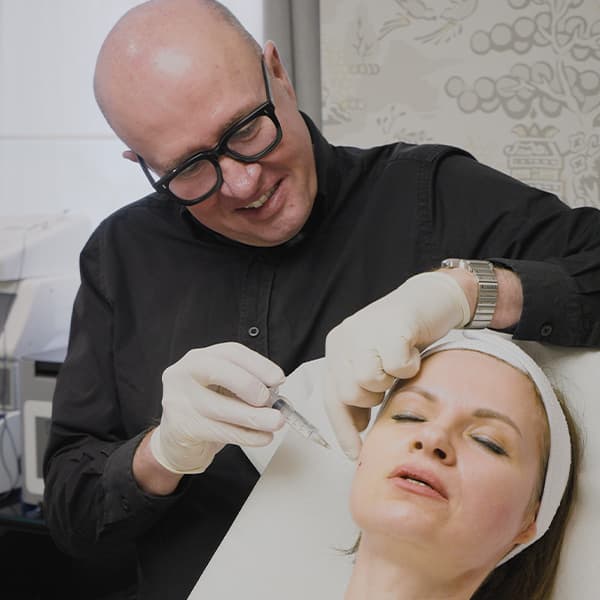
The appointment starts with your face in motion. You are asked to grimace, show your lower teeth, smile and then relax. Watching the DAO bunch along the jawline shows where it is strongest and where the tiny dose will do the most good.
Gloss collects in the small creases there, and a bright lipstick emphasises the downward line instead of lifting the face.
The doctor also feels the area gently with a fingertip while you pull the corners down. The DAO tightens under the skin like a small band, which confirms its path. Given how far it strays from the textbook position, that check matters more here than almost anywhere else on the face.
The injection point sits low, near the jawline rather than up against the lip. That keeps the product within the DAO and away from the muscles around the mouth itself. A very fine needle is used, and most people describe a quick scratch on each side.
The doses here are among the smallest of any area. Both doctors start conservatively and add a little at review if the corners would benefit from more lift. Your smile, your speech and the way you drink from a glass feel normal throughout.
Anti-wrinkle injections are a prescription-only medicine, so treatment follows a face-to-face assessment with a doctor. Dr Joney De Souza (GMC 7008632) is the founder and Medical Director, and Dr Mattia Parducci (GMC 7635663) treats alongside him. Whichever doctor assesses you treats you.
The questions come before the marking pen. When did you last have anti-wrinkle injections, and in which areas? Are you pregnant or breastfeeding, and which medicines do you take? You are also asked whether you have had filler in the chin or lower face, and when.
You are photographed at rest and while grimacing, from the front and from each side. The review is measured against those images. A corner that lifts by a millimetre is easy to miss in a mirror and easy to see side by side.
Anti-wrinkle injections relax the pull on the corners. They do not refill the hollow or fold that forms beneath them when the lower face loses volume. Dermal fillers do that, supporting the area under each corner so the marionette fold softens.
Many people have both, with the injection easing the pull and filler restoring support. Where the jawline itself has softened, the doctors talk you through options for jowls and facial laxity. Treatments are then spread over a few months.
The difference shows when you press a fingertip under the corner. If the fold lifts and the line straightens, support is missing and filler helps. If the corner only drops when you grimace, the muscle is the main story and the injection alone does the work.
Nothing visible happens on day one. Between day three and day five the downward pull begins to ease. You notice it first in a lift mirror, when your resting corners look straighter than you expected.
By about two weeks the effect has settled. The corners sit level or very slightly upturned, the small shadows below them soften, and lipstick holds its line better. Friends tend to say you look well or rested, often without guessing that anything has been done.
A review at two to three weeks is included. Because few faces are perfectly symmetrical, one corner sometimes needs a touch more than the other. The photographs from your first visit make the comparison precise.
The lift lasts around three to four months as the DAO slowly regains its strength. Many people return on a regular rhythm. Some find the habit of turning the mouth down eases a little, so the resting expression stays brighter between treatments.
Your first visit is with Dr Joney De Souza or Dr Mattia Parducci, face to face. They watch your mouth at rest and in motion and look at the jawline and the folds below the corners. You hear what the injections will change before anything is done.
Most people need one appointment and the review, then a refresh every three to four months. The consultation gives the real answer for you, and the plan and its investment are set out at that same appointment. The full range of areas is on our anti-wrinkle injections page.
The clinic is in Marylebone, close to Harley Street and a short walk from Bond Street. Patients come from Mayfair, St John’s Wood and the rest of central London, and you can read about Dr Mattia Parducci before you book. If people keep asking whether you are alright when you feel perfectly content, come and let the doctors see your resting face.
Short clips filmed at Dr Joney De Souza Clinic in Marylebone, so you can see how anti-wrinkle injections is carried out before you book.
If your mouth looks sadder than you feel, Dr Joney De Souza or Dr Mattia Parducci will watch it move and show you what a tiny dose can change. Telephone the clinic on 020 7043 0748, or start a WhatsApp chat about mouth corners.
People often arrive unsure whether their mouth corners are a muscle matter, a volume matter or both. These answers cover what we are asked most about the area and the injections.
Mostly a small muscle called the depressor anguli oris, which pulls each corner down and outwards. Years of use strengthen it, and as the skin around the lips softens with age the downward pull wins over the muscles that lift your smile. Changes along the jawline and loss of support under the corners add to the look.
They lift it subtly by relaxing the muscle that drags the corners down. The lifting muscles of the smile then act without resistance, so the corners settle level or very slightly up. It is a change of a millimetre or two, and it softens the resting expression rather than creating a fixed smile.
They overlap but are not identical. Marionette lines are the folds running from the mouth corners towards the chin, and they often come from lost volume. DAO injections relax the muscle that pulls the corners down. Many people benefit from both, with the injection easing the pull and filler supporting the fold.
Not when the dose is placed correctly. The injection goes low near the jawline, inside the depressor muscle, well away from the muscles that shape your lips. Doses in this area are kept small, and Dr Joney De Souza or Dr Mattia Parducci adds more at review only if needed.
Very often, yes. When the depressor anguli oris pulls the corners down at rest, the mouth reads as disappointed or stern in photographs and on video calls, even on a cheerful day. Softening that tug lets the corners sit level, so the expression other people see finally matches the mood you are actually in.
Usually around three to four months. The depressor muscle regains its strength slowly, so the corners drift back gradually rather than all at once. Booking again before the effect has fully worn off helps keep your resting expression steady through the year, and some people find the gap lengthens with regular visits.
Yes, the two areas sit side by side and are often treated together. The mentalis muscle in the chin causes orange-peel dimpling, while the depressor at the corners pulls the mouth down. Relaxing both gives the lower face a smoother, calmer look, and both areas are treated in one short appointment.
Because the muscle moves around from face to face. In a 2026 ultrasound study of 290 patients, most had the muscle sitting a few millimetres further out than the standard landmark. Feeling it tighten under the skin while you grimace shows exactly where your own muscle runs before the point is marked.
A simple clue is whether the corners pull down more sharply when you grimace or speak. That points to an active depressor muscle. If the corners droop at rest with a hollow or fold below, volume loss is part of the picture. Seeing your face move in person makes the answer clear.
The first change usually shows between day three and day five, when the corners stop pulling down quite so readily. The full effect settles at about two weeks. Your review two to three weeks after treatment compares your face with the baseline photographs and fine-tunes either side if needed.
