
One visit or months of them? Polynucleotides at Dr Joney De Souza Clinic in Marylebone run as a short, well spaced course. Here is what each visit does, and how you keep the glow all year.
You have decided polynucleotides are worth trying, and now the practical question arrives. Is one appointment enough, or are you signing up for months of visits? At Dr Joney De Souza Clinic in Marylebone, a polynucleotides course for most people is short and well spaced, and each visit has a clear job to do.
| Performed by | Course | Downtime | Your plan |
|---|---|---|---|
| Dr Joney De Souza or Dr Mattia Parducci | Three sessions, two to four weeks apart | Small raised dots settle within a day | Set by the doctor at consultation |
That spacing is not guesswork. Eight Italian specialists writing a consensus on PN-HPT polynucleotides set three sessions, 14 or 21 days apart, for normal facial skin, with a fourth session where ageing is more advanced.
Polynucleotides are purified fragments of salmon DNA, and they work by encouraging your own fibroblasts to repair the skin. Those cells are steady workers rather than fast ones. They need more than one prompt to rebuild collagen and elastin properly, which is why a course outperforms a single session.
Collagen is not poured into the skin like a filler. It is woven by living cells over weeks, and the fibres take time to mature and strengthen. A single dose wakes the fibroblasts up, while a series of doses keeps them working long enough to make a difference you can see in the mirror.
Think of the skin on the back of your hand when you pinch it gently. Young skin springs back at once, while thinner skin lingers in a soft ridge for a moment. Polynucleotides aim to restore that quick spring, and the snap returns gradually as each session adds structure beneath the surface.
A neck case study summarised in a 2024 review in the International Journal of Molecular Sciences compared two dosing patterns. Both improved the skin, and the regimen with multiple injections gave the more sustained result. That fits what doctors see in practice: repeated, spaced prompts outlast one large dose.
Most people at the clinic have three sessions, spaced two to four weeks apart. Three is the usual full course for the face. Patients with more advanced concerns sometimes gain from a fourth when the skin is particularly thin or sun-damaged. That spacing keeps the fibroblasts busy without asking too much of the skin at once.
The consensus figures sit inside that window. Fourteen or 21 days is two or three weeks, and the clinic stretches to four weeks when diaries or skin call for it. The eye area and the neck follow the same pattern of three or four sessions in the expert guidance, which is why the plan barely changes from one area to the next.
The wider evidence is still developing. A 2024 systematic review pooled nine studies and 219 patients and rated the quality of the evidence as low to moderate. That is the reason expert protocols carry so much weight in this field, and why your doctor sets the number from your skin rather than a fixed menu.
The first session. This is the wake-up call. A fine needle or cannula places small amounts into the mid-to-deep dermis, and tiny blebs settle within a day or two. Within days, many people see a little more hydration, with skin that looks softer at the cheekbones and less dry by the afternoon.
The second session. By now the fibroblasts are active, and the second dose builds on that momentum. This is often when people notice the glow properly. Foundation sits more smoothly, the fine crepe under the eyes is less obvious in daylight, and the skin feels more cushioned under a fingertip.
The third session. The final visit of a standard course consolidates everything. Over the following four to eight weeks, the deeper collagen and elastin changes become visible. Lines read softer in photographs, the neck creases less in a scarf, and the overall texture looks denser and more even.
Every appointment follows the same pattern. You arrive, a numbing cream sits for around 30 minutes, and the injecting takes 15 to 20 minutes. The whole visit runs to about 45 minutes, so a course fits neatly into lunch breaks.
Lines read softer in photographs, the neck creases less in a scarf, and the overall texture looks denser and more even.
What changes between sessions is the map. Dr Joney De Souza or Dr Mattia Parducci looks again at how your skin has responded and adjusts where the product goes. Areas that have thickened need less, while stubborn patches receive a little more, so every visit is tailored to the skin as it is that day.
Skin thickness is the biggest factor. Someone in their thirties with early crepe under the eyes often sees the skin brighten from the second session, with the third setting the result. Someone with years of sun and fine wrinkling across the cheeks and neck is the person most likely to gain from a fourth session.
The area matters too. The under-eye and the neck carry the thinnest skin and respond best to a full course. The mouth and lower face respond well where lipstick has started to bleed into fine lines. Treating two or three areas at once does not add sessions, since they are simply treated on the same visits.
Age plays its part, though less than people expect. A woman of sixty with well-protected skin often needs the same number of sessions as someone twenty years younger who has spent every summer in strong sun. The doctors judge by the skin they see and feel, rather than the birth date on your form.
Lifestyle plays a smaller part. Smoking, heavy sun and very little sleep all slow the skin’s repair, while daily SPF and a gentle routine help each session go further. It shows in how quickly the skin settles and how long the brightness lasts.
Some people pair the course with a hydrating treatment for a faster early lift. Profhilo works more quickly and polynucleotides more slowly, so together they cover both timescales. Others prefer skin boosters for an extra hit of moisture between visits.
The count is not fixed on the day you book. It comes from what the doctor sees in your skin. Thickness under a gentle pinch, how the surface folds when you smile, and how the cheek catches light under the lamp all count.
You are asked about your medical history, your skincare and any treatments you have had before. A fish or salmon allergy rules the course out. Cold sores matter too, because an antiviral may be advised before work around the mouth. Those answers shape the plan before the first injection.
Photographs are taken at that first visit and repeated as the course runs. They show change you would miss in your own mirror. By the second session the doctor can see how fast your skin is answering, and the fourth visit is added or left out from there.
Once the course is finished, the result lasts up to six to nine months. The collagen you have built stays, while the natural rhythm of ageing carries on. A single maintenance session every six to nine months keeps the fibroblasts active and the skin at its fresh, luminous best.
Many people book their top-up around the same time each year, often in early autumn when summer sun has taken its toll. That one visit tends to be all it takes, because you are maintaining good skin rather than rebuilding thin skin. Starting a course in the colder months also lets the collagen build while the sun is weaker.
Our article on prevention and correction looks at how regular, gentle maintenance often beats waiting for bigger changes. Polynucleotides fit that thinking well, because a little help at the right moment keeps the skin from thinning too far.
No number of polynucleotide sessions will lift a jawline that has started to soften or raise a heavy brow. The treatment improves the quality of the skin, its thickness, hydration and texture, and leaves the deeper supporting layer where it is. Adding a fifth or sixth session does not change that.
Where laxity is the concern, the doctors look at Ultherapy, focused ultrasound that reaches the SMAS, the same layer a surgeon tightens, without touching the surface. Dr Joney De Souza or Dr Mattia Parducci performs it, and polynucleotides then refine the skin that sits over the lifted layer.
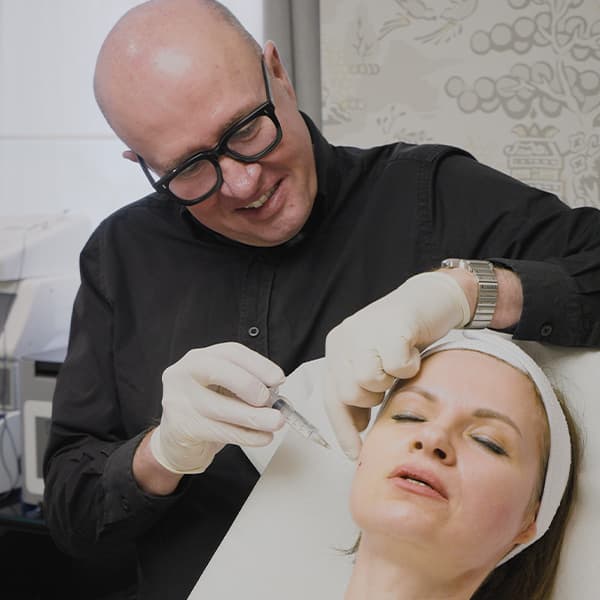
Every polynucleotide injection at the clinic is given by a doctor. Dr Joney De Souza (GMC 7008632), founder and Medical Director, and Dr Mattia Parducci (GMC 7635663) both plan and treat courses. They photograph your skin at the start, so progress is compared on the same images at each visit.
The clinic is on Blandford Street in Marylebone, close to Harley Street and a short walk from Bond Street, which makes repeat visits easy to fit into a week in central London. Your first appointment covers the consultation and usually the first session, with each later session dated so you can see the course ahead of you.
If you want a clear plan rather than guesswork, come in and let the doctors map it out with you. Read more about polynucleotides in London, then book your first session. The full details are on our polynucleotides treatment page.
Short clips filmed at Dr Joney De Souza Clinic in Marylebone, so you can see how polynucleotides is carried out before you book.
Sit down with Dr Joney De Souza or Dr Mattia Parducci, who will look at your skin and tell you how many sessions it needs and how far apart. Ring the clinic on 020 7043 0748, or send a WhatsApp message to arrange it.
Most questions about polynucleotides come down to timing: how many visits, how far apart, and how often to top up. These are the answers the doctors give most often in Marylebone.
One session brings a little early hydration, and some people notice a fresher look within days. The deeper thickening needs repeated prompts, because fibroblasts build collagen slowly. That is why a course gives a far more visible and longer-lasting change than a single appointment, particularly for the under-eye and neck.
At the clinic sessions are usually two to four weeks apart. An Italian expert consensus recommended every 14 or 21 days for the face, eye area and neck. The gap lets the skin respond to one dose before the next arrives. If a holiday gets in the way, a slightly longer gap is fine and the doctors adjust the plan.
A fourth session helps when the skin is particularly thin or has seen a lot of sun over the years. The extra visit gives the fibroblasts more time to rebuild the dermis. It is decided as the course goes on, based on how well your skin has responded by the third appointment.
After a full course, one maintenance session every six to nine months keeps the results going. Many people book it at the same point each year so it becomes a habit. A single visit is usually enough, because you are keeping good skin in shape rather than rebuilding thin skin from scratch.
The fullest change shows about four to eight weeks after your final session. Collagen keeps maturing after the last injection, so the skin often looks its best a month or two after the course ends. Comparing photographs from the first visit with that point makes the difference very clear.
No. If you treat the face, neck and décolletage together, all three are done on the same visits, so the number of appointments stays the same. Each visit simply takes a little longer. The injection map simply extends from the jaw down towards the collarbones.
You can, and you keep the hydration and early firmness those two visits have built. The doctors recommend completing the course of three, because the third session is where the deeper collagen gains become clearly visible. In the thin skin under the eyes and across the neck, that last visit is often the one that turns early freshness into lasting firmness.
A short delay rarely undoes the work. If a session slips by a week or two, the course simply picks up where it left off, because the collagen response from earlier visits builds slowly over months. A much longer gap may mean a fresh look at your skin before deciding whether to add a session. Booking all three dates at the start keeps the rhythm.
Some people do, because the two work on different timescales. Profhilo brings faster hydration, while polynucleotides build collagen more slowly. Combining them gives an early lift and a longer-term improvement. Whether it suits you depends on your skin, and the doctors will advise at your first visit.
Yes, provided you leave enough time. Start roughly three months ahead, so the course is complete and the collagen has had several weeks to mature. Your final session should sit at least a couple of weeks before the day, leaving any small blebs long gone and the skin at its brightest for the photographs.
