
You want a clear number before you book: one visit, three, or one a month? For most faces it is two PRF sessions, six to eight weeks apart, at Dr Joney De Souza Clinic in Marylebone.
You have read that PRF is the gentler, slower cousin of PRP, and now you want a clear number before you book. One visit, three, or a standing appointment every month? For most faces the answer is short: two sessions of PRF at Dr Joney De Souza Clinic in Marylebone, six to eight weeks apart.
| Performed by | Course | Downtime | Your plan |
|---|---|---|---|
| Dr Joney De Souza or Dr Mattia Parducci | PRF two sessions, six to eight weeks apart | Mild swelling for a day or two | Set by the doctor at consultation |
PRF, short for platelet-rich fibrin, starts as a small sample of your own blood drawn from the arm on the day. Dr Joney De Souza (GMC 7008632) or Dr Mattia Parducci (GMC 7635663) performs every PRF treatment in Marylebone at the clinic. The doctor in front of you decides whether a single session or the full pair suits your skin.
The difference starts in the centrifuge. The tube is spun slowly with no anticoagulant added, so the plasma sets into a soft golden gel, a fibrin net holding platelets and white blood cells. Researchers at the University of Bern found that this gel keeps releasing growth factors steadily for ten days, while PRP gives its strongest release in the first hour, in a 2016 laboratory study. That slow release is why one session does the work that a faster preparation spreads across several.
Most regenerative treatments come in long courses, so a plan of two can sound modest. It is nothing of the kind. Each PRF session keeps working long after you leave the chair, because the fibrin goes on feeding the skin. Meanwhile your fibroblasts lay down fresh collagen quietly beneath the surface.
The clinic’s standard course reflects that slow release. It is two treatments spaced six to eight weeks apart, and most people reach their best outcome from exactly that pair. The long gap is deliberate, because it gives the first wave of growth factors time to finish before the second one begins.
Picture the under-eye at week seven. The crepe that used to fold when you smiled has smoothed a little, and concealer glides on rather than catching. The skin looks rested in daylight, and that is the moment the second session is timed for, when the first has given almost everything it has.
The pair works across every area the clinic treats with PRF, from the hollow under the eyes to the cheeks, neck and décolletage. Thinning hair follows its own growth cycle, so the scalp is planned separately. The doctors look closely at the parting and the crown under good light before they set that plan.
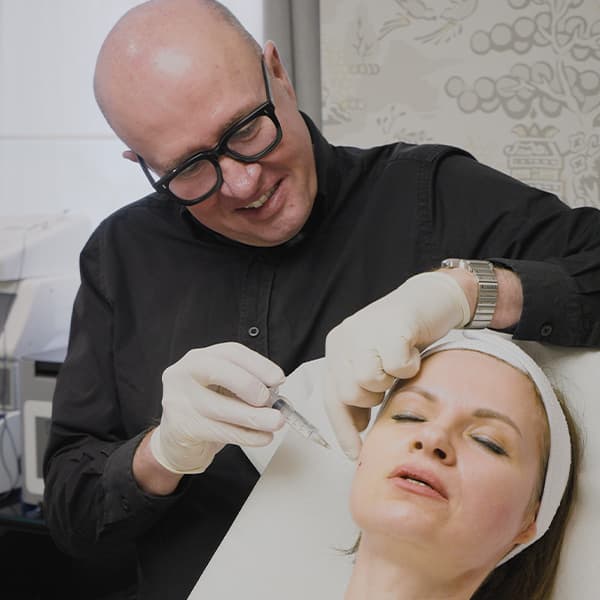
The first appointment is usually finished within an hour, blood draw and numbing included. A small sample is taken from your arm, much like a routine blood test. While it turns slowly in the centrifuge, a numbing cream settles onto the treatment area for about 20 minutes.
The injecting phase lasts between 15 and 20 minutes. A fine needle places the fibrin as a series of micro-injections into the superficial or deeper dermis, depending on the area. Under the eyes it feels like light, quick pressure along the hollow. Placement matters here, because it decides how evenly the growth factors spread through the skin.
Afterwards the skin shows small bumps, a little redness or slight swelling at the injection points. All of it settles within 24 to 48 hours. The plan is gentle skincare, hands away from the area and SPF the next morning. Skip strenuous exercise for a day and the sauna for two.
What the first session really starts stays hidden for a while. Fibroblasts in the dermis answer the growth factors by building new collagen, and hydration improves within the first few weeks. By four to six weeks the change is meaningful, and you catch yourself looking rested in the bathroom mirror.
The second visit lands on skin that is already changing. The doctors check how the first round has taken and shift the placement towards any area that responded more slowly. That might mean a little more under one eye, or along a fine line on the cheek that still catches the light.
This is where the result deepens rather than restarts. Fresh fibrin settles into tissue that is thicker and better hydrated than it was two months earlier. The new growth factors reinforce collagen that is already forming, so texture smooths further and fine lines soften. The neck looks calmer above an open collar.
That might mean a little more under one eye, or along a fine line on the cheek that still catches the light.
It is usually the stage when people notice the small things. Concealer sits smoothly instead of gathering in fine creases, and the cheek has a little more bounce when you press it. A photograph taken beside a window shows skin that looks well rested rather than tired.
Then comes the slow part, which is also the satisfying part. Optimal results develop over two to six months, and the fullest result shows at around six months. Two sessions set the process running, and your own repair carries it the rest of the way.
PRP and PRF begin in the same way, with your own blood on the day, and the difference lies in the spin. PRP is spun faster, concentrating the platelets in a liquid plasma. That liquid releases its growth factors quickly, over a shorter window. PRF is spun slowly with no anticoagulant, so the fibrin net stays intact.
That difference shapes the course. A PRP treatment plan for the face usually runs to two or three sessions, four to six weeks apart. Each burst fades sooner, so the next one has to arrive while the skin is still responding. Fibrin holds its growth factors and releases them steadily, so each PRF session covers more ground.
The result is a calmer rhythm. Two visits set further apart give the skin a long, even supply of the signals that PRP delivers in shorter bursts. That suits anyone who would rather see the doctors twice than three times. The clinic’s overview of PRP and PRF sets the two plasma treatments side by side.
The published work on PRF for the face is younger than the work on PRP, and it is growing quickly. A 2024 systematic review in Cureus gathered seven studies of injectable PRF covering 130 patients. Four of them looked at facial rejuvenation and found moderate to significant gains in texture and elasticity, with fewer visible lines.
Several of those facial studies measured the change with VISIA imaging rather than relying on photographs alone. That matters to you, because the same imaging records your skin at the first appointment here and again after the second session, so the change is measured on the same terms.
A 2025 review in the Journal of Cosmetic Dermatology looked at 14 studies of PRP and PRF around the eyes. PRF was linked with better texture, fewer wrinkles and less crepiness, while PRP had the stronger evidence for pigmentation. The authors also noted that PRF gains around the eye often softened by six months.
That finding shapes the clinic’s rhythm. The six-month mark is when your result has fully formed, and it is also the natural moment to look again. Nobody books a third session by default, but nobody leaves the skin unchecked either.
Once the pair is complete, the new collagen stays with you for a good while. It softens gradually with time, sun and ordinary ageing rather than vanishing overnight. Many people enjoy that settled, luminous result for months before they think about another visit to the clinic.
A top-up is considered once the doctors have seen your result settle at around six months. If the under-eye has stayed firm and bright, there is nothing to rush. If the crepe is creeping back or a new area has started to bother you, a further session renews the signal without repeating the whole course.
PRF does not restore lost volume. Two sessions or five, it thickens and brightens the skin rather than filling a hollow under the eye or a flattened cheek. Where volume has gone, dermal fillers supply the structure, and PRF refines the skin that sits over it. The doctors plan the order so that each one settles properly.
Your first appointment begins with a consultation with Dr Joney De Souza or Dr Mattia Parducci. They study the thickness of your skin, the depth of any hollow under the eyes and the texture across the cheeks and neck. VISIA skin imaging records the starting point, so you can compare the same views after your second session.
On average a PRF course is two sessions six to eight weeks apart, though the consultation gives the real answer for your skin. Dr Joney De Souza or Dr Mattia Parducci sets out the plan and its investment at that first visit, whether it covers the face alone or the neck and décolletage as well.
A few questions come before any blood is drawn. Do you take aspirin, fish oil or another supplement that thins the blood, and can it be paused for a few days? Have you had fillers, lasers or plasma around the eyes before, and when? Which part of the face bothers you most in a photograph taken by a window?
Arrive at each session with clean skin and no make-up on the treatment area. Booking both dates at the start keeps the six to eight week rhythm steady through a busy season, and the second date is already waiting for you when the first result starts to show.
The clinic is on Blandford Street in Marylebone, a short walk from Baker Street and Bond Street, and simple to reach from anywhere in central London. Patients have given it a 4.9 Google rating across more than 270 reviews. Book a PRF course in London and leave your first visit with both sessions already in the diary.
Short clips filmed at Dr Joney De Souza Clinic in Marylebone, so you can see how prp and prf is carried out before you book.
Curious whether a pair of PRF sessions will bring brightness back to your under-eyes and cheeks? Dr Joney De Souza or Dr Mattia Parducci will study your skin and set both dates with you. Ring 020 7043 0748 or send the clinic a WhatsApp message to book.
From spacing your visits to timing a top-up, these are the questions people ask when they are working out how many PRF sessions to book at Dr Joney De Souza Clinic in Marylebone.
Fibrin releases its growth factors slowly over days and weeks, so each PRF session keeps working after you leave. Two treatments six to eight weeks apart give the skin two full waves of repair. That is where most people reach their best outcome. A further session only comes later, as a top-up, if your skin would clearly benefit.
Four weeks is a little early for PRF. At that point the fibrin from your first session is still feeding the skin, and its collagen is still forming. Waiting six to eight weeks means the first wave has finished by the time you return. The second session then builds on a complete result instead of interrupting one.
A single session gives a fresher, better hydrated look within a few weeks, which suits an event on its own. For a deeper change in texture and crepiness, start the pair around three to four months ahead. Both sessions are then done, and the skin has several weeks to settle before the photographs begin.
Weathered skin still starts with the standard pair. It tends to build collagen more slowly, so the doctors watch how it has responded after the second session. If the texture would benefit from another push, they suggest a top-up. Pairing PRF with a tightening treatment is sometimes the better route, and that is agreed at the consultation.
Most people notice a clear difference in the weeks after the second visit, as the under-eye brightens. The texture across the cheeks smooths at the same time. A slower refinement follows over the next few months while collagen matures. The fullest result arrives at around six months from the start of the course, with gentle improvement beyond that.
Most people find it easier, simply because they know the rhythm of the visit. There is the blood draw, then the numbing cream, then a short run of fine injections. The skin is often a touch firmer by then. The small bumps afterwards fade within a day or two, just as they did the first time round.
Shadows caused by thin skin and a hollow respond well to the standard pair. The plasma thickens and brightens the skin over the darker area, so the shadow softens. Circles that come mainly from pigment respond better to a different approach, and the doctors tell you which kind you have. Read more on our dark circles page.
Yes. The face and neck count as two areas, so both are treated at each of your two visits, in the same appointment. Adding the neck does not add an appointment to the course. It receives finer, more superficial placement, because its skin is thinner than the skin over the cheek.
It comes down to the spin. The gentler spin and the absence of additives let PRF set into a soft fibrin gel, which holds its growth factors and lets them out slowly over the following weeks. PRP releases its signal faster, so it relies on more frequent visits. The doctors choose whichever plasma suits the area, not the one with the shorter course.
There is no fixed calendar. A 2025 review of 14 studies found that PRF gains around the eye often softened by six months, so the doctors look at your result at that point. A further session is suggested only when the skin has started to lose the firmness and brightness the pair built. Daily SPF protects the new collagen between visits.
