
A flatter cheek in a shop window, a temple that has hollowed a little. Here is how Julaine, a collagen stimulator, rebuilds that support in your cheeks and temples in Marylebone.
Your new security pass arrives at work, and you hold it next to the old one from five years ago. In the new photo the cheek looks flatter, the temple has hollowed a little, and the light slides off where it used to catch. Julaine at Dr Joney De Souza Clinic in Marylebone is a collagen stimulator built for that slow loss of support.
| Performed by | Course | Results | Your plan |
|---|---|---|---|
| Dr Joney De Souza or Dr Mattia Parducci | Two to three sessions | Build over two to three months, last up to two years | Set by the doctor at consultation |
It is given by Dr Joney De Souza (GMC 7008632) or Dr Mattia Parducci (GMC 7635663). Both are doctors, and both plan the course from the face in front of them rather than a fixed number of syringes.
The early numbers are why the name keeps coming up in conversations across London. Two months after a first dose, 63.9 percent of patients in a Spanish study had measurably softer folds between the nose and mouth, and the same share had regained some volume in the mid-face.
Julaine is a next-generation poly-L-lactic acid formula developed by Nordberg Medical in Sweden. PLLA is biocompatible and biodegradable, so the body breaks it down slowly and nothing stays in the tissue for good. What stays is the collagen your own skin lays down while the particles are present.
The material has a long history in aesthetic medicine. An injectable PLLA was first approved by the US Food and Drug Administration in August 2004, originally to restore facial fat loss. Julaine refines that same idea with a newer formula, and the Spanish study above is part of the clinical work now being published on it.
That study was an interim analysis of 36 adults treated at three centres, with three sessions about a month apart. It was funded by the manufacturer and is still running, so the doctors read it as an early signal rather than the final word. The early signal is encouraging, and it matches what the treatment is designed to do.
Filler places a gel under the skin and the shape changes on the day. Julaine works the other way round. The microspheres sit in the deeper layers of the skin and prompt the fibroblasts, the cells that make collagen, to lay down fresh fibres around them.
The Spanish team tracked this directly. Levels of P1CP, a marker released when new type I collagen is made, rose significantly one month after the first dose and then held steady. Type I collagen is the strong, rope-like protein that gives skin its density and spring.
As those fibres build up over weeks, the cheek regains its curve from within. The skin over it thickens, so it feels firmer under your fingertips and holds foundation more smoothly. Because the support is your own tissue, the face moves and reads exactly as it always has.
That is the difference people notice in the treatment chair as well. Nothing is sculpted on the spot. There is no moment of seeing a new face in the mirror and wondering whether it suits you. The cheek simply looks a little more like it did a few years ago, a little more each month, while the skin over it gains a finer, denser finish.
Because the support is your own tissue, the face moves and reads exactly as it always has.

Julaine suits early to moderate laxity, a loss of facial support, reduced firmness, and skin that has turned thin or dull. The cheeks and mid-face are the most common areas, followed by the temples and the jawline. In some faces the lower face and neck are included too.
The flattened cheek. When the soft pad over the cheekbone loses density, the highlight drops lower and a shadow gathers beside the nose. Rebuilding collagen across that area lifts the highlight back up, and the face looks open again in photographs.
The hollow temple. The shallow dip at the side of the forehead often goes unnoticed until you pull your hair back. Julaine restores a soft curve here, so the tail of the eyebrow sits on a fuller frame and the eyes look less tired.
The thinning jaw. Along the jawline, thinner skin lets the edge blur where it meets the neck. Fresh collagen gives that skin more spring, and the line reads cleaner in profile over the months that follow.
Julaine does not give instant volume or a sharply sculpted edge. It builds gradually, which is its strength. A jaw angle or chin that needs a defined new shape on the day is better served by dermal fillers. Some plans use both, with filler for the outline and Julaine for the skin quality around it.
The doctors make that call from your face at rest and in conversation. If Dr Joney De Souza or Dr Mattia Parducci believes filler, or another treatment entirely, would suit you better, they will tell you before anything is prepared.
The first visit is a face to face skin consultation in Marylebone. The doctor looks at the cheek, temple and jaw from the front and in profile, under soft and direct light, and judges how much support has gone and where.
Then come the questions that shape the plan, starting with whether you have had filler before, which product it was and when it was placed. Are you pregnant or breastfeeding? Do you have an autoimmune condition, an active skin infection near the area, or a history of keloid scarring? Have you had recent dental work? Each answer changes the timing, and some change the treatment.
Where earlier filler is still doing a lot of work, a short wait comes first so the new collagen builds on settled tissue. For the 48 hours before treatment you set aside aspirin, ibuprofen, fish oil and vitamin E. Each one makes bruising more likely, and alcohol waits for 24 hours.
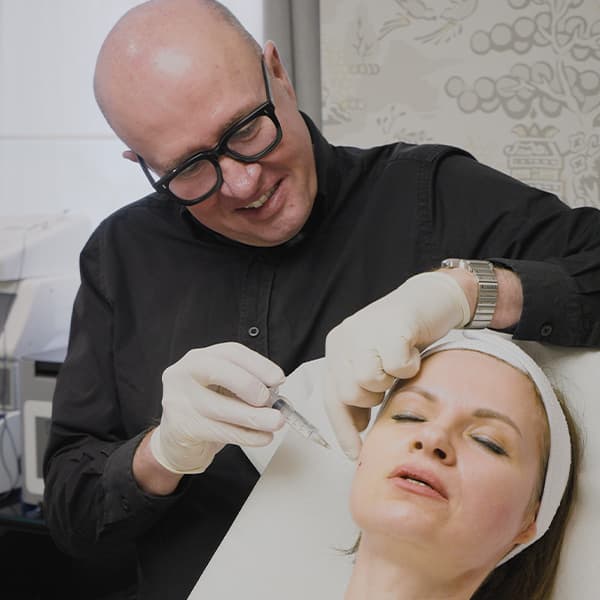
From arrival to leaving, the appointment takes 45 to 60 minutes. Your skin is cleansed and a numbing cream goes on for around twenty minutes. Injection points are marked from the plan, and the injecting itself takes twenty to thirty minutes.
Depending on the area, the doctor uses a fine needle or a slim cannula that glides beneath the skin from a single entry point. Most people feel mild pressure and a brief sting at each point. A short massage follows straight away to spread the product evenly through the tissue.
Afterwards there may be a little redness, swelling or tenderness, which usually settles within 24 to 48 hours. Many people go straight back to their afternoon. You keep up the massage at home as shown, and for 48 hours you avoid hard exercise, saunas and strong sun.
Any early fullness from the fluid the product is carried in fades within days, and then the real change begins. Results show over four to twelve weeks after each session and keep improving for several months beyond that.
Most people notice it first on an ordinary morning. The cheek catches the bathroom light again and the shadow beside the nose looks lighter. Friends tend to say you look rested without being able to name what has changed, because nothing changed overnight.
Julaine is usually given as two or three sessions spaced four to eight weeks apart, each one adding to the collagen the last one started. The result lasts twelve to twenty-four months, and for some people up to two years or more. A maintenance session later on keeps that structure strong.
Side light shows the change best. Stand by a window and the curve under the cheekbone throws a shallower shadow than it did before the course began. The skin there looks finer too, with make-up sitting on it rather than in it, and the temple meets the hairline in one smooth line.
For long-term support the PLLA family has a track record. In a randomised trial in the Journal of the American Academy of Dermatology, 116 people treated with injectable PLLA kept their improvement in smile-line wrinkles for up to 25 months after the last session. That durability is what draws people to collagen stimulators in the first place.
Most people need two or three sessions. The consultation gives the real answer, since every face loses collagen in its own pattern and at its own pace. The plan and its investment are set out at that first appointment, with dates attached, so you know what each session is for.
Julaine also sits well beside treatments that work at the surface. Polynucleotides, Profhilo and Morpheus8 can join the plan, with the timing set so the deeper support and the surface glow improve together.
The clinic sits in Marylebone, close to Harley Street and an easy walk from Baker Street and Bond Street stations. People come from Fitzrovia and St John’s Wood for Julaine in central London, and the visit fits into a long lunch. More than 270 Google reviewers have rated the clinic 4.9 out of 5.
If the face in the shop window looks more tired than you feel, book a first visit and let the doctors show you what your own collagen can rebuild. The Julaine treatment page sets out every step of the course.
Short clips filmed at Dr Joney De Souza Clinic in Marylebone, so you can see how collagen stimulators is carried out before you book.
If your cheek or temple has lost its fullness, come and see Dr Joney De Souza or Dr Mattia Parducci about Julaine. They will study your face in changing light and plan the course. Ring 020 7043 0748 to book, or send the team a WhatsApp.
Julaine is new to many people in London, so the same questions come up at almost every first visit. Here are the answers our doctors give, with the published research linked where a figure appears.
Julaine is a poly-L-lactic acid formula from Nordberg Medical in Sweden. The microspheres are fully absorbable, so the body clears them gradually while they signal your skin to produce fresh collagen. Nothing in it is permanent, which is part of why the result looks like your own face on a good day.
No. Filler places volume beneath the skin the moment it goes in, and the shape changes in the mirror straight away. Julaine adds almost nothing on the day. It prompts your skin to grow its own support over the following weeks, so the change reads as rested rather than reshaped.
In an interim analysis of 36 adults at three Spanish centres, 44.4 percent had softer smile-line folds one month after the first dose, rising to 63.9 percent at two months. Mid-face volume scores followed the same pattern. The study was funded by Nordberg Medical and is still collecting longer follow-up.
The clinic treatment page puts it at twelve to twenty-four months, and for some people up to two years or more. How long yours lasts depends on how strongly your skin responds and how many sessions you complete. A maintenance session later on keeps the new collagen holding well.
Give it a few weeks. Improvement builds over four to twelve weeks after each session and continues for several months. Most people spot it when foundation glides over the cheek more easily, or when the temple no longer shows a dip as they tie their hair back.
Most people find it very manageable. Numbing cream goes on for about twenty minutes first, and during the injections you feel mild pressure with a brief sting at each point. The cannula option means fewer entry points, which many patients prefer along the cheekbone and jaw.
Usually, yes. Many people return to normal activities the same day, and 24 to 48 hours is the outer limit for most. Any redness or mild swelling settles within that window. The area can feel slightly tender for three to five days, mainly when you press on it.
Massage spreads the product evenly through the tissue, which keeps the finish smooth as collagen forms around it. The doctor shows you exactly how before you leave. It takes a few minutes, a few gentle strokes along the cheekbone in front of the mirror, morning and evening.
Often you can, though timing matters. Dr Joney or Dr Mattia will ask which product was used and when, then look at how the cheek sits now. Where earlier filler is still holding a lot of shape, they suggest a short wait so the new collagen builds on settled tissue.
Yes. Men lose support at the temples and under the cheekbones too. The skin along the jaw thins with age in the same way. The doctors place Julaine to keep a male face angular, so the result reads fitter and more rested rather than rounder or softer.
