
One friend swears by Sculptra, another has just had Julaine, and both tabs are open on your phone. Here is how the two collagen stimulators differ and how the doctors choose.
One friend swears by Sculptra, another has just had Julaine, and two browser tabs sit open on your phone. Both promise a fuller cheek without the filled look. At Dr Joney De Souza Clinic in Marylebone the doctors use both Julaine and Sculptra, and they choose between them face by face.
| Performed by | Course | Results | Your plan |
|---|---|---|---|
| Dr Joney De Souza or Dr Mattia Parducci | Two to three sessions | Build over two to three months, last up to two years | Set by the doctor at consultation |
Every injection of either is given by Dr Joney De Souza (GMC 7008632) or Dr Mattia Parducci (GMC 7635663). Neither is delegated to a therapist or a nurse injector, because a collagen stimulator is planned around anatomy rather than a menu.
The first difference is track record. Sculptra was approved by the US Food and Drug Administration in August 2004, while Julaine published its first clinical results in March 2025. Both are built on poly-L-lactic acid, so the choice between them is less about the ingredient and more about your face, your history and the timing.
Neither is delegated to a therapist or a nurse injector, because a collagen stimulator is planned around anatomy rather than a menu.
That 2004 approval went to Q-Med AB of Uppsala, for restoring facial fat loss. Sculptra has more than two decades of clinical use behind it, and it arrives as a suspension of fine PLLA microparticles prepared at the clinic. It contains no donor tissue and nothing derived from animals.
Julaine comes from Nordberg Medical, also in Sweden, and is described as a next-generation PLLA formula. Its microspheres are fully absorbable, like Sculptra’s particles. The difference is age and evidence:
The first of those, an interim analysis of 36 adults in Spain, found 63.9 percent had softer nasolabial folds two months after the first Julaine dose. It was funded by the manufacturer and is still collecting longer follow-up. For Sculptra, the long view already exists in published trials.
None of that makes Julaine the lesser choice. Newer formulas are refined from what earlier ones taught injectors, and Julaine at Dr Joney De Souza Clinic is planned with the same care as its older cousin. It simply means the doctors weigh a shorter track record alongside the newer design when they pick one for you.
Both treatments follow one biological route. The particles sit in the deeper layers of the skin and prompt the fibroblasts, the cells that build collagen, to lay down fresh fibres. As the body slowly absorbs the particles, those cells keep working and the cheek gains density from within.
You leave either appointment looking much as you arrived. Any early fullness is mostly the water the product was carried in, and it fades within days. Then the scaffolding that time thinned beneath the cheekbone starts to rebuild, and the face fills with soft light over the following months.
The PLLA family has been tested over long periods. In a randomised trial published in the Journal of the American Academy of Dermatology, 116 people treated with injectable PLLA held their smile-line improvement for up to 25 months after the final session. The comparison group, treated with collagen implants, did measurably worse from month three to month thirteen.
The rhythm of the course. Sculptra sessions are usually six to eight weeks apart. One vial per session is the usual starting point, and most people have two or three vials across a course. Julaine is planned as two or three sessions spaced four to eight weeks apart.
The first glimpse. Sculptra shows its first change around six to eight weeks after the opening session, then keeps developing over three to six months. Julaine improves over four to twelve weeks after each session, with the cheek still gaining softness and spring for several months afterwards.
How long the support stays. Sculptra results last eighteen months to around two years, with maintenance every twelve to eighteen months. Julaine is listed at twelve to twenty-four months, and for some people up to two years or more, depending on how the skin responds.
The areas on the map. Sculptra is used at the temples, cheeks and cheekbones, the jawline, the chin and the skin around the mouth. Julaine covers the cheeks, temples, jawline and mid-face, reaching the lower face and neck in some faces. The overlap is wide, so the decision rests on your face rather than the leaflet.
The aftercare at home. Sculptra comes with the five, five, five rule: massage for five minutes, five times a day, for five days. Julaine is massaged too, following the pattern the doctor shows you before you leave.
Neither collagen stimulator lifts tissue that has slipped. They rebuild density and firmness in the skin, but a jowl that has dropped because the deep supporting layer has loosened needs a different tool. That layer, the SMAS, is what Ultherapy reaches with focused ultrasound and real-time imaging.
A simple mirror test shows which you need. Press your fingertips gently upwards at the cheekbone. If the jaw sharpens, part of the change is laxity, and a lift belongs in the plan. If the cheek still looks flat while you hold it, collagen is the missing piece, and many faces show some of both.
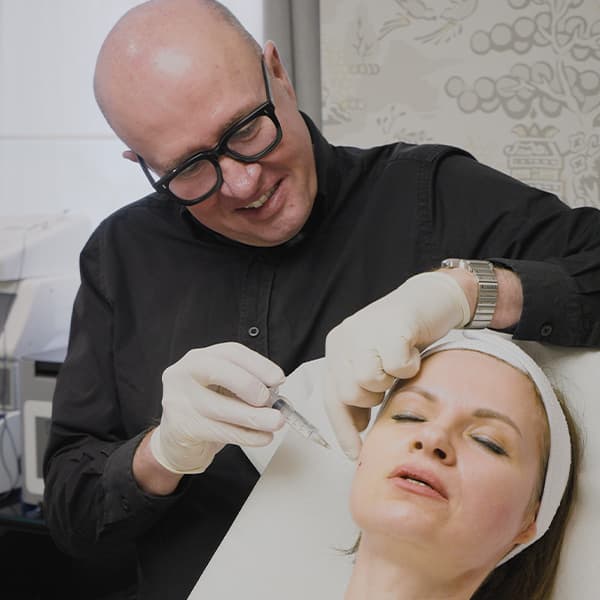
From the patient side the two appointments feel very alike. Each takes 45 to 60 minutes, starting with a numbing cream that needs about twenty minutes to take hold. The injecting itself runs for twenty to thirty minutes while the cream tingles faintly across your cheeks.
For Julaine the doctors choose a fine needle or a cannula depending on the area, and Sculptra is placed in the same careful way. Most people describe a gentle pressure with a brief sting, and the temple usually feels the lightest of all. A massage follows straight away.
Afterwards the skin looks a little pink and puffy, and that settles within a day or two. The area stays tender to press for three to five days, so sleep on your back for the first night. Hard exercise, saunas and strong sun wait for 48 hours.
By the third month the difference shows most in side light. The hollow under the cheekbone casts a shallower shadow, the temple curves into the hairline, and make-up sits on skin that feels firmer under your fingertips. Whichever formula you chose, the face looks like yours on a well-rested day.
The decision is made in the room, with your face in front of the doctor. Dr Joney or Dr Mattia look at where support has thinned, how the light falls across the cheek, how deep the temple hollow runs and how the skin over the jaw springs back when pinched.
Then they ask what has gone before. Which filler have you had, where, and how long ago? Have you had a collagen stimulator in the past, and how did your skin respond? Are you pregnant or breastfeeding, and do you have an autoimmune condition or a history of keloid scarring? Is there an event ahead with a fixed date?
Preparation differs slightly. Sculptra asks you to set aside aspirin, ibuprofen, fish oil and vitamin E for the week before, while Julaine asks for 48 hours. For both, alcohol waits for 24 hours and you arrive with clean skin, mentioning any recent dental work or infection near the area.
Julaine’s reach into the lower face and neck suits someone who wants support below the jaw. Sculptra’s long record around the chin and mouth makes it a natural pick when the lips need a firmer frame. Where filler is still present, the doctors often suggest a short wait first.
Your skin type plays a part as well. Thin skin over a deep temple hollow behaves differently from thicker skin across a broad cheek, and the doctors judge that by touch as much as by eye. The answer is one formula, chosen for the skin and the area that matter most to you.
Your first appointment is with Dr Joney De Souza or Dr Mattia Parducci in Marylebone. They photograph your face, ask what you have noticed in the mirror and set out what each formula would do for it. You leave knowing which one they recommend and why.
Most people need two or three sessions of either, and the consultation gives the real answer. The course and its investment are set out once the doctors have seen how your cheeks and temples catch the light. The Julaine treatment page and the Sculptra treatment page hold the full detail.
For a wider view, our guide to skin boosters and collagen stimulators shows where hydrating injectables fit beside them. Many plans pair a collagen stimulator for structure with a hydrating injectable for glow, each booked on its own day so the skin answers one thing at a time.
The clinic sits in Marylebone, a short walk from Regent’s Park and Baker Street, and many people fit the visit around a morning in Mayfair. Choosing between two collagen stimulators is exactly what a doctor-led clinic in central London is for, so close the tabs and book a first visit.
Short clips filmed at Dr Joney De Souza Clinic in Marylebone, so you can see how collagen stimulators is carried out before you book.
Not sure whether Julaine or Sculptra suits your face? Dr Joney De Souza or Dr Mattia Parducci will study your cheeks and temples and recommend the right one. Phone 020 7043 0748, or send a WhatsApp message to book.
Choosing between two collagen stimulators raises plenty of practical questions. These are the ones people in our Marylebone treatment rooms ask most, with the research linked where a figure appears.
They come from the same ingredient family. Both are built on poly-L-lactic acid, a biocompatible material the body absorbs slowly. Sculptra is made by Galderma and has two decades of use behind it. Julaine is a newer Swedish formula from Nordberg Medical, with its microspheres refined for current injecting techniques.
The ranges overlap closely. Sculptra is listed at eighteen months to around two years with maintenance, and Julaine at twelve to twenty-four months, sometimes longer. A randomised PLLA trial recorded improvement holding for up to 25 months. In real faces, skin response and session count matter more than the label.
Neither wins outright. Both are used at the temples here, and both restore a soft curve to the hollow beside the brow. The choice depends on the depth of that hollow, the thickness of the skin over it and the plan for the rest of your face.
Yes, and some patients do. Both build collagen rather than sitting as volume, so one course can build on the structure the other started. Bring the dates of your previous sessions, and the doctors look at how your cheek has held since that last course before setting the next step.
You do. Sculptra follows the five, five, five routine, and Julaine also needs massage as shown on the day. It takes a few minutes with clean fingertips and a little moisturiser, and it keeps the finish smooth. Most people do it at the bathroom mirror, morning and night.
Both are slow by design, which is what keeps them natural. Julaine starts showing change between four and twelve weeks after a session, and Sculptra from around six to eight weeks. Either way you tend to notice the difference somewhere in the second or third month.
No enzyme dissolves PLLA the way hyaluronidase dissolves filler. Neither treatment creates sudden volume, so the result arrives gently and then softens gently as the body absorbs the particles. That is why the doctors plan the course session by session, adding only what the face needs.
Sculptra has two decades of trials and FDA approval dating back to 2004. Julaine is newer: its first published interim study followed 36 adults in Spain and reported softer folds in 63.9 percent at two months. Longer studies are running, and the doctors weigh that difference when they choose.
Absolutely. Men lose support in the temples and under the cheekbones too. A collagen stimulator rebuilds it without softening the strong lines of a male face. The doctors place the product to keep the jaw and cheek angular, so the result reads fitter and more rested.
Either works if you start early enough. Allow two or three sessions plus a couple of months of building, so six months ahead is comfortable. If the date is closer, the doctors will suggest a faster option alongside, and the final session still settles well before the photographs.
