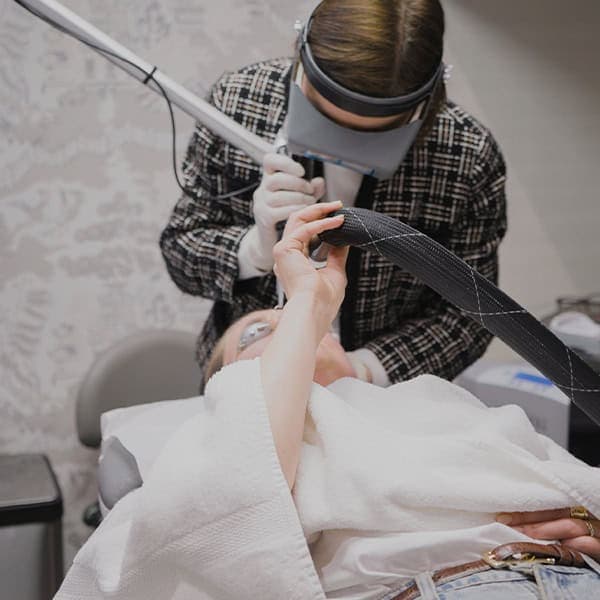
Under eye shadows have three quite different causes and only one of them is pigment. Which you have decides whether laser will help, and telling them apart takes about ten minutes.
Dark circles are one of the most common things patients raise at Dr Joney De Souza Skin & Laser. They are also one of the most misunderstood. The phrase covers at least three separate problems that happen to look similar in a bathroom mirror.
The first is genuine pigmentation, sometimes called periorbital hyperpigmentation. Melanin has gathered in the thin skin under the eye, often in a fairly even band. It is more common in deeper skin tones and it frequently runs in families. It tends to stay the same regardless of how much sleep you have had.
The second is hollowing. Volume has been lost beneath the eye, or the tear trough has deepened with age. What you are seeing is a shadow cast by shape rather than colour. Press gently and the darkness does not really change, but tilt your face towards a light and it can lift dramatically.
The third is vascular. The skin under the eye is the thinnest on the body. The blue and purple tones you see are the vessels beneath it showing through. This is the version that genuinely does look worse when you are tired or dehydrated.
Here is why the distinction matters. A pigment laser works on colour, so it addresses the first of those three directly and does nothing for the other two. Any honest conversation about treating dark circles starts with working out which you have. Most people have some combination rather than one alone. Our dark circles and eye bags page sets out the full range of options for this area.
The skin under the eye is around half the thickness of skin on the cheek, which is precisely why it has historically been treated with caution. Older lasers delivered much of their effect as heat. Heat in an area this thin and this close to the eye is not something you want more of than necessary.
PicoSure Pro works differently, and the difference is the whole reason this area is treatable at all. Each pulse lasts around a trillionth of a second, which is faster than heat can travel. The energy arrives as a sharp pressure wave that shatters pigment where it sits and leaves the surrounding tissue cool.
Less heat means less inflammation, and less inflammation matters more here than almost anywhere. The skin under the eye is also the area most inclined to respond to being irritated by producing yet more pigment, which is the opposite of the result anyone wants.
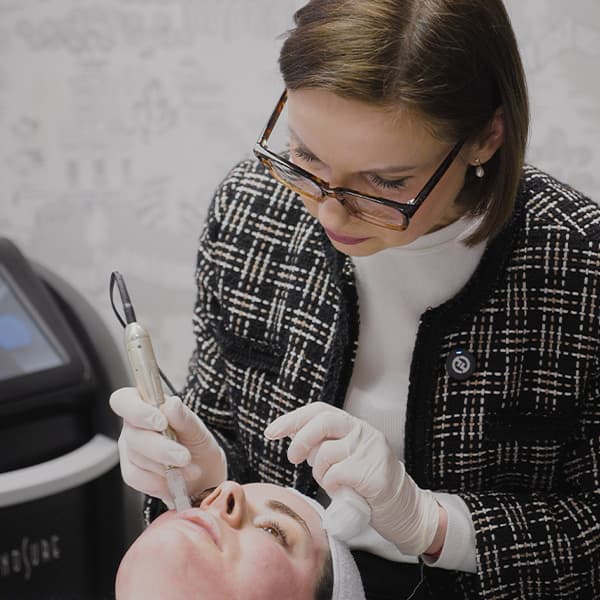
Spot size helps too. Our system arrived with five handpieces, the 755nm zoom plus four fixed 532nm heads at 5mm, 6mm, 8mm and 10mm. A smaller spot gives a practitioner far more control in a confined area than a broad one ever could. Under the eye we work at 755nm and size the beam down through the zoom, which keeps the spot tight without bringing a surface-absorbed wavelength close to the orbit.
The eye itself is shielded throughout the session, and settings are kept deliberately conservative. This is not the area to be ambitious in. A good result here looks like gradual, even lightening rather than anything dramatic.
Sessions are short, usually well under half an hour for the eye area alone. Numbing cream goes on beforehand and cooling is used throughout. Most patients describe the sensation as a series of quick, warm snaps.
Afterwards you can expect some pinkness and mild warmth for a few hours, occasionally into the next day. There is no removal of the skin surface, so there is nothing to heal in the way an ablative treatment would leave. Most people go straight back to their day, though the area can look a little puffy for the first evening.
A course of three sessions four to six weeks apart is the usual plan, with brightening often visible after the first and the fuller change developing over the following two to four weeks. The eye area is priced as a focal area, from £320 a session with a course of three from £864. The full breakdown sits on the PicoSure treatment page.
Daily SPF is what protects the result, and sunglasses do more for this area than any cream. Ultraviolet light deepens existing pigment and encourages new pigment. The skin here is thin enough to show that faster than anywhere else on the face.
Everything begins with a face-to-face consultation at our Marylebone clinic, and for this concern the assessment does more work than the treatment does.
We look at the area in good light and under magnification. We look at it from more than one angle, because that is how hollowing reveals itself. Where pigment is layered or hard to read by eye, VISIA skin analysis shows what is actually sitting below the surface.
If pigment is the main driver, laser is a sensible plan and we will say so. If the shadow is mostly volume, you will hear that instead. The honest answer may be that a filler or a polynucleotide treatment would serve you better than any laser. If it is vascular, we will tell you that too. Being sent to the right treatment is worth more than being sold this one.
You will also have a patch test before your first full session, which matters here because the surrounding skin is unforgiving of settings chosen optimistically.
Sessions are carried out by Roma Sumskiene, our Advanced Skin and Laser Specialist, who is Level 4 qualified and has run hundreds of PicoSure sessions. Dr Joney De Souza provides the clinical oversight, so the settings chosen for an area this delicate are a medical decision.
If you have been looking at the same shadows for years without knowing what causes them, ten minutes with a practitioner will answer it. Book a consultation at our Marylebone clinic, or see current prices first.
Pigment, hollowing and visible vessels all read as dark circles in the mirror and each one needs something different. A consultation at our doctor-led Marylebone clinic settles which you have under magnification, so the plan you leave with is the one that will actually work.
Questions our Marylebone team hears most about treating the area under the eyes.
It depends entirely on what is causing them. Where the darkness is pigment sitting in the skin, a pico laser targets it directly and clears it well. Where it is a shadow cast by hollowing, or the blue tone of vessels showing through thin skin, laser will not help and something else will. Your assessment separates the three.
A useful home test is light. Tilt your face upwards towards a window and if the darkness lifts noticeably, shape is a big part of it. Pigment stays much the same whatever the angle. It is only a rough guide, and looking at the area under magnification from several angles is what settles it properly.
It is the clinical name for genuine pigmentation in the skin around the eye, usually appearing as a fairly even band of brown or grey under the lower lid. It is more common in deeper skin tones and often runs in families. Being pigment rather than shadow, it is the version that responds to laser.
Yes, with the right precautions, and they are not optional. The eye is shielded throughout the session, settings are kept deliberately conservative. A smaller spot size is used for the confined area. It is also why we patch test first and why this treatment belongs in a doctor-led clinic rather than a salon.
Less than most people expect. Numbing cream goes on beforehand and cooling is used throughout. Most patients describe a series of quick, warm snaps rather than sustained discomfort. Sessions for the eye area alone are short, usually well under half an hour including numbing time.
A course of three sessions four to six weeks apart is the usual plan, with brightening often visible after the first. Your own number depends on how deep the pigment sits and how much of your shadow is pigment in the first place. Your practitioner confirms it at your assessment.
Very little. Expect some pinkness and mild warmth for a few hours, occasionally into the next day. The area can look slightly puffy for the first evening. The skin surface is never removed, so there is nothing to heal in the way an ablative treatment would leave behind.
Often yes, because hereditary dark circles are frequently pigmentary rather than structural, and pigment is what this laser clears. What treatment cannot change is the tendency itself, so daily sun protection is what keeps the result. Your assessment will tell you which part of yours is treatable.
The eye area is priced as a focal area, from £320 a session with a course of three from £864. If you are treating the under eye area alongside a wider concern such as the full face, the pricing follows the larger area rather than adding the two together. The full table sits on our PicoSure treatment page.
Then we will say so at your consultation. Where the shadow is mostly volume loss, a filler or polynucleotide treatment may serve you far better. Where it is vascular a different approach applies again. Sending you to the treatment that will work is more useful to both of us than selling you this one.