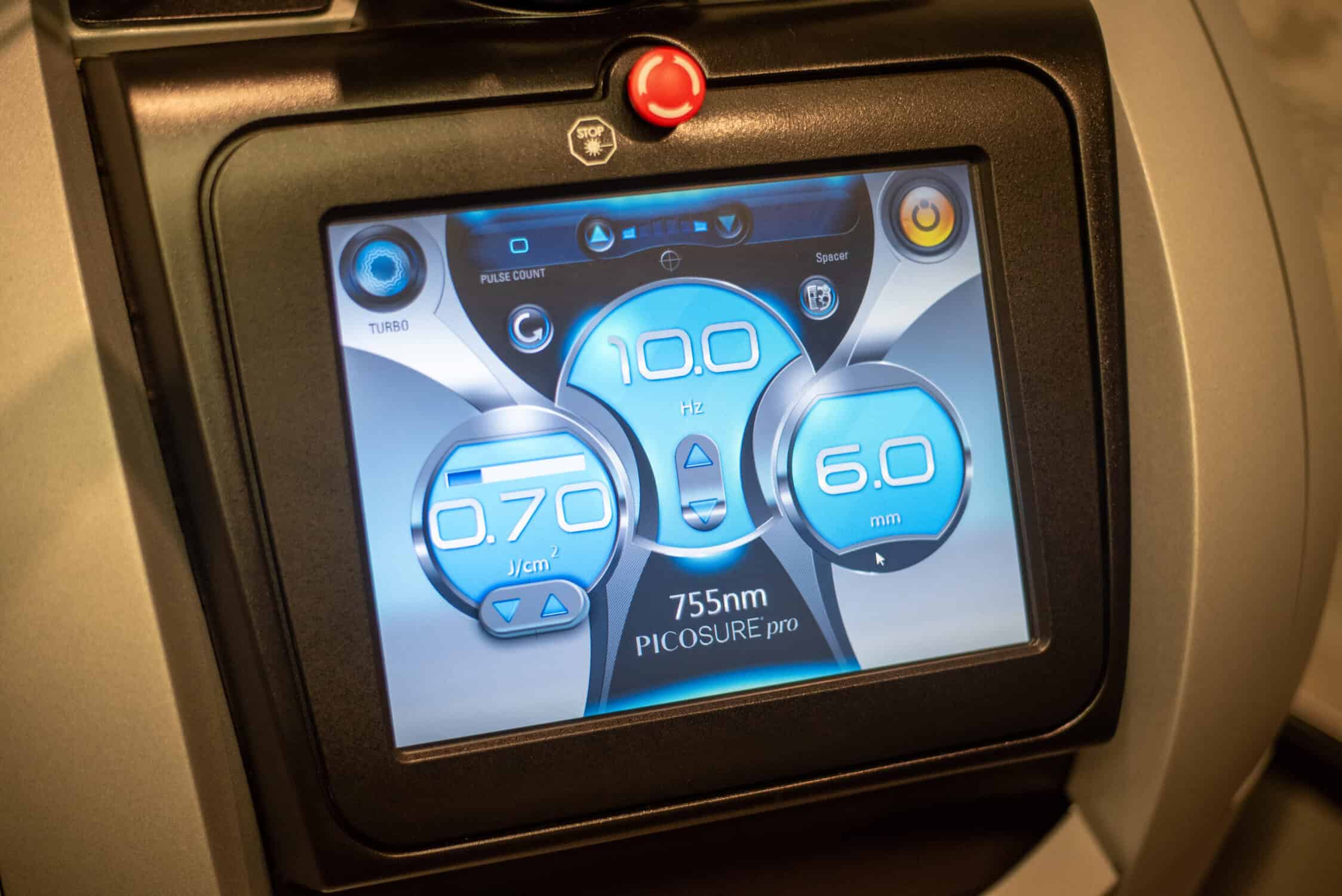
PicoSure Pro is the current generation of the laser that changed pigment treatment. Here is what carried over, what the extra power actually buys you, and how it shapes a course.
Dr Joney De Souza Skin & Laser has treated pigmentation with picosecond technology for years. The arrival of PicoSure Pro in our Marylebone treatment room is an upgrade rather than a departure. The idea underneath it is the same one that made the original such a useful laser. It is worth understanding before the differences make any sense.
Both lasers work at 755nm. That is the wavelength brown pigment absorbs most readily. Only one of them also works at 532nm, and that is where the real difference starts. It is why an alexandrite laser suits sun damage, age spots and uneven tone so well. Both fire in picoseconds, meaning each pulse lasts roughly a trillionth of a second.
That number sounds like showing off until you see what it buys. Pigment sitting in your skin holds heat for a fixed moment before that heat starts spreading sideways into the tissue around it. Deliver your energy faster than that window and the heat has nowhere to go. The pulse arrives as a sharp mechanical pressure instead, shattering the pigment where it sits and leaving the skin around it cool.
Older lasers had to warm the skin to do the same work, which is why they asked more of it and why recovery took longer. A pico laser does not, and three things follow. The surface of your skin is never removed. Most patients go back to work the same day. And so little heat reaches the surrounding skin that settings can be calibrated across a wider range of skin tones. Older devices could not handle that range comfortably.
None of that changed with the Pro. It is the foundation both generations stand on, and it is the reason this laser earned its reputation in the first place.
The headline difference is a second colour of light. The original PicoSure worked at 755nm alone. PicoSure Pro carries 755nm and 532nm, and the shorter of the two changes what can be reached.
Depth is the reason. 755nm travels further into the skin, which is what makes it the wavelength for pigment sitting deeper down and the safer choice across a broad range of skin tones. 532nm is absorbed hard right at the surface, so it suits a sun spot with a sharp edge to it, a scatter of freckles, and the warm ink colours that 755nm passes over. It is chosen selectively rather than used by default, and on deeper skin tones or on melasma we stay with 755nm. Wavelength gets decided before any setting does.
The next difference is power. PicoSure Pro delivers that same picosecond pulse at higher energy, and power is what buys precision rather than force.
Here is why that matters. A laser is only as adaptable as the range it can work within. Push a system to the edge of its output and there is nowhere left to go, so the practitioner settles for the nearest usable setting. Give the same practitioner more headroom and they can choose the setting your skin actually wants. They can then move it as your skin responds through a course.
The third difference is the hardware that comes with it. Our system arrived with five handpieces: the 755nm zoom, plus four fixed 532nm heads at 5mm, 6mm, 8mm and 10mm. The Focus lens attachment then splits the 755nm beam into a grid of concentrated points, which is the rejuvenation side of the platform. Spot size decides how the energy lands, so five options mean the beam is sized to the job rather than the job to the beam.
Put the extra power and the extra spot sizes together and the picture changes. One appointment can go gently and broadly, the next narrowly and firmly.
Ranges and specifications are abstract until they change what happens to your face, so here is the practical version.
Pigmentation is rarely one thing. A patient often arrives with sun damage across the cheekbones, a scattering of freckles and a few post-acne marks. Add a patch of melasma, which behaves differently from all of it. Those concerns sit at different depths and tolerate different amounts of energy. Treating them identically is how results end up uneven.
More range lets one plan hold all of it. A broad, conservative pass can even out overall tone. A smaller spot at a different setting then does concentrated work on the marks that need it. Melasma in particular rewards restraint. It responds to heat as well as to light. Treatment that is too aggressive can leave it more stubborn. Having the room to go gently is exactly what that condition asks for.
Deeper skin tones benefit for the same reason. Skin richer in melanin has more of it everywhere, not only in the mark being treated, so keeping the thermal load low is what protects it. A wider set of settings plus a smaller spot gives a practitioner more control over precisely that. It is why picosecond systems widened the range of complexions that can be treated at all.
The same speed also breaks down tattoo ink. Black and dark blue respond strongly at 755nm, and so do the greens and blue-greens that older single-wavelength machines so often left behind. Red, orange and yellow are a different job, and that is what the 532nm side is for. Tattoo work is assessed and priced separately, and the detail sits on our PicoSure tattoo removal page.
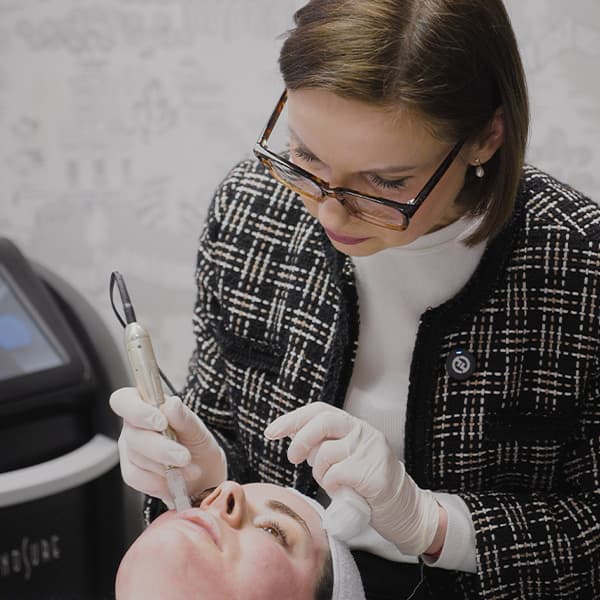
PicoSure Pro is the system we treat with at our Marylebone clinic. Most of that work sits with Roma Sumskiene, our Advanced Skin and Laser Specialist. Roma is Level 4 qualified and has run hundreds of PicoSure sessions. Pigment rewards a methodical operator, and that experience is worth more than any specification on a brochure.
Dr Joney De Souza provides the clinical oversight. Your settings are a medical decision rather than a default pulled from a menu. Every first treatment is preceded by a consultation and a patch test. The plan you start is built on how your skin actually behaved, not on how it was expected to.
A course of three sessions four to six weeks apart is the usual shape for pigmentation, with brightening often visible after the first. Those are averages, and your own number comes from your assessment. Sessions start from £320 for a focal area such as the eye or mouth area. A full face is from £475, with a course of three from £1,282. The full breakdown sits on the PicoSure treatment page.
Been looking at the same marks for years? Half an hour will tell you what this laser can do about them. Book a consultation at our Marylebone clinic, or have a look at our prices first.
Pigmentation, melasma, sun damage and tattoo ink all respond to this laser, and each one has its own settings and its own timeline. A consultation at our Marylebone clinic identifies what you are dealing with and confirms your course before anything begins.
Questions our Marylebone team hears most about the two generations of this laser.
Both are 755nm picosecond lasers, so the way they clear pigment is the same. The Pro adds a second wavelength at 532nm, and that is the real difference. A shorter wavelength is absorbed right at the surface, which suits sharply defined sun spots, freckles and the warm ink colours 755nm passes over. Each pulse acts faster than heat can spread, which breaks pigment apart by pressure rather than by warmth. PicoSure Pro delivers that pulse at higher power and arrives with five handpieces, the 755nm zoom and four fixed 532nm heads. The range of settings and spot sizes available to your practitioner is wider. The gain is precision rather than force.
It is the same technology with more headroom, so nothing that worked before has been given up. What the extra power adds is adaptability. Your practitioner matches the laser to your skin type and to the depth of the pigment. Settling for the nearest setting is no longer necessary. Better is not quite the right frame. More adjustable is closer to it.
Yes, and the list has grown rather than changed. Sun damage and age spots, melasma, post-inflammatory pigmentation, freckles, uneven tone, under eye pigmentation and superficial acne scarring all respond, and so does tattoo ink. Most of that work is done at 755nm. Surface marks such as a sharply defined sun spot or a scatter of freckles often answer better to 532nm, which is why the Pro carries both. Your consultation confirms which of them applies to your skin.
We would not promise that. A course of three sessions four to six weeks apart remains the usual plan for pigmentation. Your own number depends on your skin, the depth of the pigment and how quickly your body clears it. What the extra power changes is how precisely each session can be set.
Two things at once, wavelength and spot size. The zoom handpiece delivers 755nm and the four fixed heads at 5mm, 6mm, 8mm and 10mm deliver 532nm. Spot size then decides how the laser energy lands. A 10mm spot covers a full face or décolletage efficiently. A 5mm or 6mm spot concentrates energy on one mark or a small delicate area. The zoom handpiece adjusts between sizes without changing hardware mid-treatment, so the beam is matched to the area rather than the other way round. Alongside them sits the Focus lens attachment, which splits the 755nm beam into a grid of concentrated points for rejuvenation work.
It is the wavelength that brown pigment absorbs most readily. That is what makes an alexandrite laser so well suited to sun damage, age spots and uneven tone. The energy is drawn to the colour you want gone. A picosecond pulse delivers it fast enough to break that pigment apart without warming the skin around it. 532nm matters for the opposite reason. It is absorbed before it travels far, so it concentrates on pigment sitting at the surface and on the warm ink colours 755nm barely touches. Two wavelengths mean the light is matched to the depth and the colour, not only to the concern.
Very little. Some warmth and pinkness for a day is typical, and most patients return to normal routine the same day. The surface of the skin is never removed, which is the main reason recovery is so straightforward compared with ablative laser treatments.
Not really, and comfort is something we plan for. Numbing cream goes on beforehand and cooling is used throughout. Most patients describe the sensation as a series of quick snaps rather than sustained discomfort. Allow around 30 minutes of numbing time before the session itself.
Pricing follows the area treated. A focal area such as the eye or mouth area starts from £320. A full face is from £475, and a course of three from £1,282. Larger combinations such as face, neck and décolletage are priced accordingly, and the full table sits on our PicoSure treatment page.
Your sessions are delivered by our trained laser and skin specialists, with most PicoSure work handled by Roma Sumskiene, our Advanced Skin and Laser Specialist. Dr Joney De Souza provides the clinical oversight, so the settings chosen for your skin are a medical decision. Laser treatment at the clinic is not performed by Dr Joney personally.