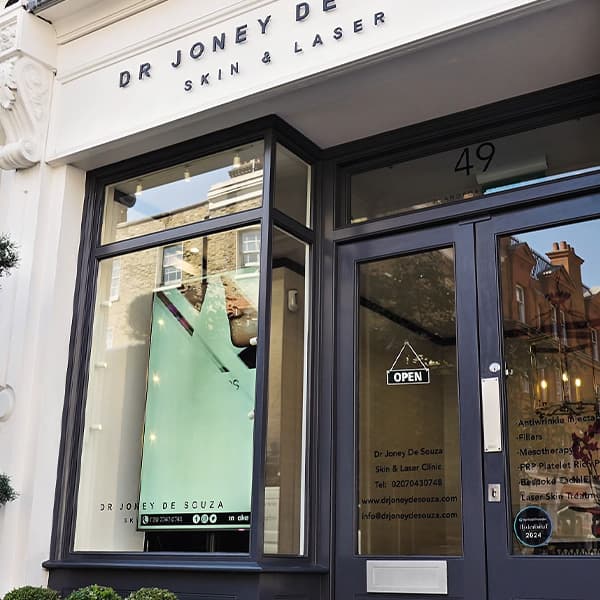
Sculptra vs Radiesse. What is the difference? The team at Dr Joney De Souza in london explore how these collagen treatments compare.
Written by the team at Dr Joney De Souza 5th February 2026
Loss of collagen is one of the central biological processes underpinning facial ageing. From the age of the mid-20s onwards, collagen production gradually declines, contributing to changes in skin firmness, elasticity, and structural support. This manifests not only as fine lines, but as broader shifts in facial architecture, including reduced resilience of the skin and soft tissue.
In recent years, there has been renewed interest in treatments that work with the body’s own regenerative capacity rather than relying solely on replacement volume. Injectable collagen stimulators sit within this category. Rather than filling lines directly, they are designed to encourage the skin and underlying tissues to produce new collagen over time.
Two of the most widely discussed collagen-stimulating injectables are Sculptra and Radiesse. While they are often grouped together in patient consultations, their mechanisms, behaviour, and clinical applications differ in important ways.
At Dr Joney De Souza’s clinic in Marylebone, injectable collagen stimulation is approached as part of a broader, anatomy-led treatment strategy rather than as a standalone solution.
Collagen stimulators are not skin boosters. Nor are they traditional dermal fillers. Their purpose is not immediate surface hydration. They also do not replace lost volume in a single sitting.
Instead, collagen stimulators like Sculptra and Radiesse gently encourage your skin to repair and strengthen itself. The building blocks of each product are placed into the deep layers of the skin. For Sculptra, this is Poly-L-Lactic Acid. There they stimulate fibroblasts. This activates your body’s natural collagen production over time.
Rather than creating instant change, the skin gradually becomes firmer as new collagen forms. These results develop slowly and naturally. So treatments like Radiesse and Sculptra need careful planning, clear expectations and expert assessment. This makes sure they suit the right patients and are used in the right way. If you are weighing up Sculptra vs Radiesse in London, we will explain how each fits your skincare plan. At Dr Joney De Souza, that starts with a bespoke, individual consultation.
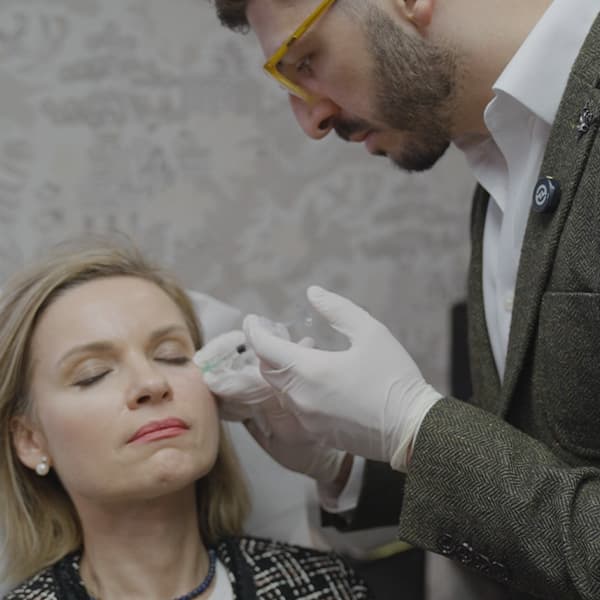
Sculptra is made from poly-L-lactic acid (PLLA). This biodegradable synthetic material has been used in medicine for decades, including in dissolvable sutures. When injected, Sculptra particles act as a scaffold within the tissue. They do not create volume in the traditional sense. Instead, they stimulate the body’s natural collagen production. This happens over weeks to months as the material is gradually broken down.
Results with Sculptra develop slowly. They need a series of treatment sessions spaced over several months. This staged approach lets collagen build progressively. The outcome is gradual improvement in skin density and structural support.

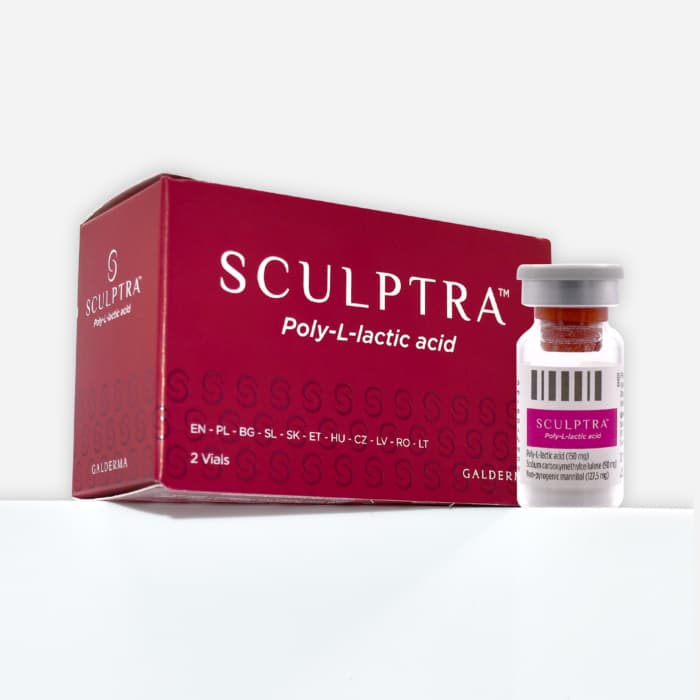
Radiesse is made from calcium hydroxylapatite microspheres suspended in a gel carrier. Calcium hydroxylapatite occurs naturally in bone and teeth. In injectable form, it has a well-established safety profile.
Unlike Sculptra, Radiesse gives some immediate structural support at the time of treatment. This comes from its gel component. Over time, the carrier gel is absorbed. Meanwhile, the calcium hydroxylapatite particles stimulate collagen production in the surrounding tissue.
This dual action means Radiesse offers both short-term contour support and longer-term collagen stimulation. In experienced hands, it is used to improve skin firmness, definition and tissue quality. It is not used to create visible volume. At Dr Joney De Souza’s clinic, Radiesse is used selectively. Careful attention is paid to anatomy, depth and dilution, depending on the treatment goal.

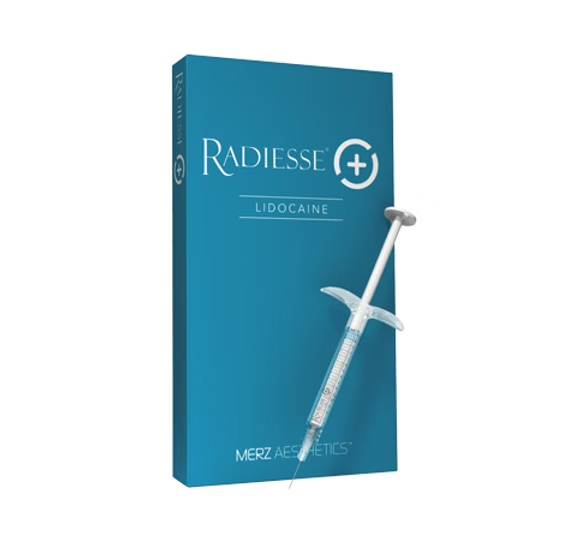
Although both treatments stimulate collagen, their behaviour within skin layers is quite different. Sculptra works primarily as a long-term collagen biostimulator, with minimal immediate structural effect. Its results depend heavily on correct reconstitution, injection technique, and appropriate patient selection. It also requires frequent massage after the treatment which can be complicated for the patient.
Radiesse, by contrast, has a more immediate mechanical presence in skin tissue before transitioning to a collagen-stimulating role. This makes it more versatile in certain areas but also requires advanced understanding of facial anatomy to use safely and effectively. Neither treatment should be considered interchangeable, and they are not combined without clear clinical rationale. At Dr Joney De Souza in Marylebone, London we will assess your needs during a thorough consultation and explain the best treatments for your personal case.
Both Sculptra and Radiesse are often described as longer-lasting injectable treatments. Longevity depends on many factors. These include metabolism, lifestyle, skin quality and treatment approach.
Sculptra results may last up to two years in appropriately selected patients. This follows a full treatment course, though results vary. Maintenance treatments may be needed to sustain collagen levels over time.
Radiesse typically offers visible improvement for around 12 to 18 months. This again depends on how it is used and where it is placed. Longevity should not be the only driver of treatment choice. You wouldn’t choose a permanent filler simply because it lasts longer. Our faces change over time. That is why it is important to consult an expert, such as Dr Joney De Souza or Dr Mattia Parducci. This applies to any collagen stimulator, and to any injectable treatment, whether fillers, skin boosters or Polynucleotides.

Injectable collagen stimulators demand strong anatomical knowledge and technical skill. Their delayed action carries a risk. Errors in placement or product choice may only appear weeks or months later. Dr Joney De Souza’s clinic takes a conservative, anatomy-led approach to collagen stimulation.
Treatments are planned around long-term patient health, not isolated correction. Experience matters when managing the amount of product, its depth and its distribution. It also matters when deciding whether a collagen stimulator is appropriate at all.

Is Sculptra the same as Radiesse?
No. Both are injectable collagen stimulators. But they are made from different materials and behave differently.
Which collagen stimulator lasts longer, Sculptra or Radiesse?
Longevity varies by individual. Radiesse typically lasts around 12 to 18 months.
Sculptra is often linked with longer-term collagen stimulation. Results can last up to two years in appropriately selected patients.
Sculptra is an injectable biostimulatory treatment made from Poly L Lactic acid (PLLA). Rather than acting as a traditional dermal filler, it works by stimulating the skin’s natural collagen production over time. This gradual process helps restore volume, improve skin firmness and support long term facial rejuvenation.
Sculptra helps restore lost facial volume, improve skin firmness and enhance overall facial structure. It is commonly used to treat hollow temples, sunken cheeks, jawline laxity and general facial ageing by supporting the skin’s natural collagen framework.
Sculptra and Radiesse can add volume over time but they are not primarily volumising treatments. Any volume effect is indirect and related to improved collagen quality rather than filler-like augmentation.
Discomfort is usually mild and managed with appropriate technique and local anaesthesia where required.
Most patients experience minimal downtime, though swelling or bruising can occur temporarily.
When used appropriately and conservatively results are typically subtle.
No. Unlike hyaluronic acid fillers, collagen stimulators are not easily reversible once placed, this is why its important to seek the expertise of our team for these kind of treatments.
Yes. Radiesse is used selectively at the clinic following consultation and assessment.
Patients with certain medical conditions, unrealistic expectations, or those seeking immediate dramatic change may not be suitable.
Yes, but only following careful assessment and with a clear treatment plan.
Radiesse may offer some immediate support, but true collagen stimulation develops gradually over time.
Our patients return to us year after year for natural, balanced results. Every review reflects our commitment to precision, safety and a personalised approach to aesthetic care.
Based at 49 Blandford Street in Marylebone, the Dr Joney De Souza Skin & Laser Clinic is well known. Its approach to aesthetic medicine and skin health is refined and personalised. The clinic offers a carefully curated range of advanced treatments. These include Skinvive by Juvéderm, designed to improve skin quality, hydration and radiance while preserving natural facial expression.
Every aesthetic treatment gets the same attention to detail and clinical integrity. The focus is long-term skin health, not short-term cosmetic change. Through thorough consultation and tailored planning, patients are guided towards subtle, effective solutions. These support healthy, luminous skin over time.