
You grew a fringe to hide the stripes across your forehead, and foundation still finds them. Forehead lines treatment in Marylebone softens them while your brows still move.
You have grown a fringe partly to cover them, and foundation settles into them by the afternoon. Every time you raise your eyebrows in conversation, three or four horizontal stripes stretch across your forehead. Forehead lines treatment at Dr Joney De Souza Clinic in Marylebone smooths those stripes while your brows still lift, frown and tell the story of what you are saying.
| Performed by | Appointment | Downtime | Results |
|---|---|---|---|
| Dr Joney De Souza or Dr Mattia Parducci | About 15 minutes | None, straight back to your day | Begin in three to five days, settle at two weeks |
The secret is restraint. The forehead muscle is the only one that raises your eyebrows, so it needs a light, carefully spread dose rather than a heavy one. Placed well, the treatment calms the deep folding and leaves a gentle range of movement. Dr Joney De Souza (GMC 7008632) or Dr Mattia Parducci (GMC 7635663) treats every forehead.
Forehead lines rarely travel alone, and the strongest evidence treats them alongside the frown. In a placebo-controlled trial of 391 adults, the forehead and frown were treated together. After 30 days, 61.4 percent of the treated group had forehead lines at least two grades better, against none of those on placebo.
The frontalis is a broad, flat muscle that runs vertically from the eyebrows up into the scalp. When it contracts, it pulls the brows upward and pleats the skin above them into horizontal folds. Many of us use it constantly without realising, lifting the brows to look interested, to read small print or to keep tired eyes open.
Those folds fade in young skin as soon as the muscle rests. With time, collagen in the forehead thins and the lines stay a little longer after each lift. Eventually they show faintly at rest, most clearly under overhead lighting, which drops a shadow into each groove.
Some foreheads carry two long, even lines. Others show a scatter of shorter creases that break up across the middle. The pattern depends on how your frontalis is shaped, and that is the first thing Dr Joney De Souza or Dr Mattia Parducci study when you lift your brows for them.

The frozen forehead people worry about comes from too much product placed too evenly, often too close to the brow. The skin turns glassy and flat under the light, and the eyebrows stop moving at all. It is a look many people associate with anti-wrinkle injections, and it is entirely avoidable.
The doctors work the other way. Small doses are spaced across the upper and middle forehead, where the folding is deepest. The lowest band of muscle, just above the brow, keeps more freedom, so the eyebrows hold their lift and the face still reads expressive.
The result is a forehead that softens rather than stills. When you raise your eyebrows, the skin wrinkles lightly instead of folding into deep stripes. Friends notice that you look fresher and more rested without being able to say what changed.
Men often prefer an even lighter touch here, since a mobile brow is part of how they come across at work. Women who wear their hair swept back tend to ask for a little more smoothing. Both are easy to tailor, because the dose is decided point by point.
When you raise your eyebrows, the skin wrinkles lightly instead of folding into deep stripes.
Your forehead is in a constant tug of war with the muscles between the brows. The frontalis pulls up, while the frown muscles pull down and inward. Relax only the forehead and the downward pull wins slightly, so the brows feel heavier than you would like.
The larger trials reflect that balance. A 2018 phase 3 study of 787 adults split each dose between the forehead and the frown, with or without the crow’s feet. At 30 days, forehead lines were at least two grades better in 45.6 percent and 53.0 percent of the two treated groups, against 0.6 percent on placebo.
The frown muscles do more than crease the skin. In a 2007 analysis of 79 women treated between the brows alone, the outer brow rose first and the centre of the brow followed, peaking at 12 weeks. Relaxing the muscles that drag the brow down lets it sit a fraction higher, which brightens the eyes.
Anti-wrinkle injections are a prescription-only medicine, so they follow a face-to-face assessment with a doctor. Dr Joney De Souza is the founder and Medical Director, and Dr Mattia Parducci practises alongside him. Either doctor sees you, plans the dose and treats you.
Before anything is drawn up you are asked when you last had anti-wrinkle injections and where, whether you are pregnant or breastfeeding, and which medicines you take. The doctors also ask whether your upper lids feel heavy by evening. Many people lift their brows all day to keep tired eyes open, and that changes where the doses go.
Some people bring a photograph from a few years ago. It shows where the brows used to sit and how the forehead looked before the lines settled, and it often guides how much lift to preserve.
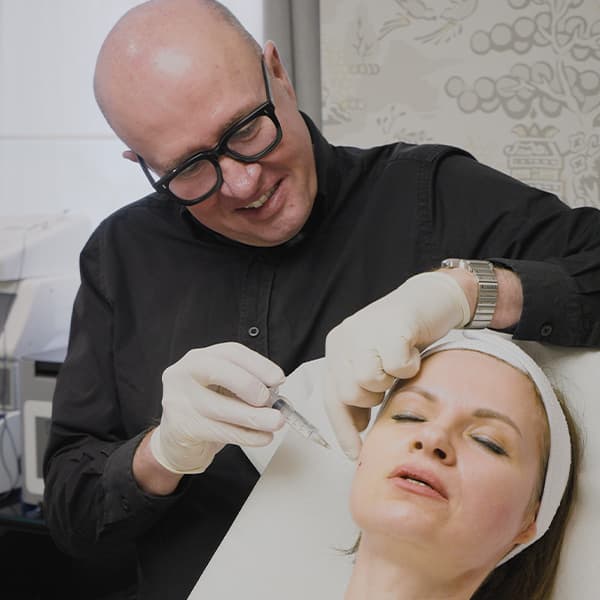
You sit upright while the doctor marks a few points across your forehead with a white pencil. The needle is very fine, and each injection feels like a brief pinch followed by a cool sting. The forehead has little padding, so you feel the needle clearly, and each point is over in a second.
The appointment takes around fifteen minutes. Tiny bumps rise where each dose went in and flatten within the hour. You can walk back to an office in Fitzrovia or straight to a lunch near Bond Street with nothing more than faint pink dots, which a little powder covers.
For the rest of that day avoid pressing the area, skip hats that sit tight on the forehead, and leave strenuous exercise until tomorrow. On day three to five you raise your brows and feel the skin fold less. By about two weeks the effect has settled, and you return for a review of symmetry.
Each round of smoothing lasts around three to four months. Movement returns gradually, so the lines reappear softly rather than all at once. Booking your next visit when the folds start to show again keeps the forehead smooth through the seasons.
Forehead injections soften the lines the frontalis draws. They do not lift a heavy brow or tighten hooded upper lids, because that heaviness comes from skin and support rather than muscle. A forehead that has been working hard to hold the lids open needs a lighter dose and a different partner.
Ultherapy provides that lift. Its focused ultrasound reaches the SMAS, the supporting layer a surgeon tightens, without touching the surface, and Dr Joney De Souza or Dr Mattia Parducci performs it. Results build over two to three months, and the forehead then has less work to do.
You can try a simple test in the mirror. Close your eyes, let your forehead go completely slack, then open them without lifting your brows. If the lids feel heavy and the brows sit low, the forehead dose is planned around that, and Ultherapy often comes first.
After years of folding, some forehead lines are etched into the surface itself. Anti-wrinkle injections still help, because the skin finally gets a long rest from creasing. Over several rounds those lines look shallower, and foundation glides over them instead of collecting in them.
The forehead faces the sky more than any other part of the face, so it gathers years of sun exposure. A daily SPF protects the smoother skin and keeps the texture between the lines even and bright.
Where the etching is deeper, pairing injections with a skin treatment brings extra smoothness. Skin boosters hydrate the forehead from within and give it a soft finish. Our page on wrinkled skin shows how the doctors combine treatments when lines sit at rest.
Your first visit is with Dr Joney De Souza or Dr Mattia Parducci at our clinic in Marylebone, moments from Harley Street. They ask you to raise your brows, frown and relax, note how your forehead folds, and go through your medical history. Treatment can usually happen the same day.
The plan and its investment are laid out before a single dose is drawn, and our anti-wrinkle injections page shows every area and how they combine. Most people return three or four times a year. Some need treatment less often once the lines have softened, and the consultation gives the real answer for your forehead.
Patients travel from across central London to the clinic, and our guide to anti-wrinkle treatments covers the wider picture. If forehead lines are the first thing you notice in the mirror, come and let us see how your brows move.
Short clips filmed at Dr Joney De Souza Clinic in Marylebone, so you can see how anti-wrinkle injections is carried out before you book.
If forehead lines catch your eye every morning, come and meet Dr Joney De Souza or Dr Mattia Parducci in Marylebone for a natural, light-handed plan. Ring 020 7043 0748, or start a WhatsApp chat with the team.
Here is what people tend to ask before smoothing their forehead, covering eyebrow movement, make-up, deeper etched lines and how far ahead of a big occasion to book.
Not when the dose is planned around your brows. The lowest part of the forehead muscle is left freer so it can keep lifting, and the frown muscles are often treated too, which stops them pulling the brow down. Most people find their brows feel light and sit at their natural height.
Simply ask for it. The dose is set point by point, so the doctors can leave a gentle range of motion while still softening the deepest folds. Many people prefer that look, since a forehead that moves a little reads relaxed and natural in conversation and on camera.
Liquid foundation sits on the skin and then slips into any fold as you move, drawing a fine line of colour along every crease. Once the folding softens, the base stays smooth across the forehead for much longer, and many people find they can wear lighter coverage.
It is possible, though most faces look better when both are done. The frown muscles pull the brows down, while the forehead muscle lifts them. Treating only one side of that balance leaves the brows feeling lower. Treating the pair in one sitting keeps the brows level and the whole upper face reading calm.
Forehead doses are often lighter than people expect, because the aim is softening rather than stillness. The number depends on the width of your forehead, the strength of the muscle and how much movement you want to keep. The doctor confirms the dose with you before treatment starts.
By then the effect has settled. At rest the forehead looks smoother and calmer, and when you raise your brows you see soft, shallow creases instead of deep stripes. Overhead light falls evenly across the skin, which gives the whole upper face a fresher look.
Yes, gradually. Relaxing the muscle stops the line being folded again and again, so the groove has time to soften over a few treatment rounds. For deeper etching, the doctors add a skin quality treatment such as skin boosters to speed the improvement and add glow.
Gradually, and gently. Around three to four months after treatment the frontalis begins to recover its strength, so your brows rise a little higher with expression and the faint lines return first on tired days. Nothing snaps back overnight, which leaves plenty of time to book your next appointment.
Yes. With a natural dose you can still lift your brows, just with less folding above them. The movement looks softer and the lines lighter. If you prefer a smoother finish with less lift, that can be planned too, and the review lets you fine-tune the next round.
Book about three to four weeks ahead of the wedding. That gives the effect two weeks to settle fully and leaves time for your review appointment if anything needs balancing. Booking much earlier than six weeks means you are further through the results when the photographs are taken.
