
Your own video call thumbnail looks cross while you are simply thinking. Frown lines treatment in Marylebone maps your 11s and softens them, so you look focused, not annoyed.
The barista hands over your coffee with a grin and tells you to cheer up, because it might never happen. You were in a perfectly good mood, thinking about nothing more serious than lunch, yet the two deep grooves between your brows told a different story. Frown lines treatment with anti-wrinkle injections at Dr Joney De Souza Clinic in Marylebone softens exactly those grooves.
| Performed by | Appointment | Downtime | Results |
|---|---|---|---|
| Dr Joney De Souza or Dr Mattia Parducci | About 15 minutes | None, straight back to your day | Begin in three to five days, settle at two weeks |
The 11s are carved by a compact cluster of muscles no bigger than a fingertip on each side. Ease their pull by a careful amount and the skin above them stops creasing, with Dr Joney De Souza or Dr Mattia Parducci holding the needle.
Not every frown draws a neat pair of 11s, though. When dermatologists in India photographed 200 people frowning before their first treatment, they sorted the lines into six distinct patterns, which they labelled 11, U, Pi, X, W and I. Each pattern pointed to a different set of muscles doing the work.
Doctors call this region the glabella, the smooth patch of skin between the eyebrows and just above the nose. Underneath it sits the glabellar complex, a group of small muscles that draw the brows together and down. Every time you focus, squint or worry, they contract and fold the skin.
The corrugator supercilii is the main culprit. It runs from the bridge of the nose out along the inner brow. When it tightens, both brows slide towards the midline, and that inward pull pleats the skin into the vertical grooves of the 11s.
The procerus sits lower, right over the bridge of the nose. When it contracts it drags the inner brows downwards and draws a short horizontal crease across the top of the nose. In anyone who reads closely or squints at screens, these muscles work all day long.
A smaller muscle, the depressor supercilii, helps lower the inner end of each brow. It rarely acts alone, and in some faces it adds to the heavy, knitted look. Watching all of these muscles move together is what lets the doses land where they make the most visible difference.
Strong, frequent contraction is why frown lines often appear earlier than forehead lines or crow’s feet. Some people see faint 11s in their late twenties. Men usually have larger corrugators and need a little more product for the same softening.
The Indian study, published in 2019, built its six patterns from three things:
The authors then set doses for the muscles that mattered most in each pattern, noting that dosing has to be individual.
A Korean study of 139 first-time patients reached a similar point in 2014 with five patterns. The panel recommended higher doses and more points for the most heavily used muscles. Muscles that barely moved were left alone or given less, which the authors said gave more natural results.
You can find your own pattern in a mirror. Frown hard and look at where the deepest line forms, whether the skin at the root of the nose bunches, and whether the lower forehead creases too. Then relax and see which of those marks stays behind.
In the chair that means a single deep groove and a fan of three short lines are treated differently. A frown that pulls hard inward needs more along the corrugators, while one that drags the brows down leans on the procerus.
Ask a friend to frown hard and the 11s appear in almost anyone. These are dynamic lines, visible only when the muscles move. Over time the skin is folded along the same path so often that a faint groove stays put even when you are completely calm.
A frown that pulls hard inward needs more along the corrugators, while one that drags the brows down leans on the procerus.
Under overhead office lighting a resting line throws a small shadow between the brows, and side lighting from a window makes it look deeper still. Foundation settles into the crease by mid-afternoon, drawing a thin pale line along the very thing you hoped to cover.
Anti-wrinkle injections work best on dynamic lines and on resting lines that are still shallow. Once the creasing stops, the skin has the chance to smooth, and many resting lines soften over two or three treatment cycles. The injections relax the muscle, though, and they do not rebuild a groove etched into the skin itself.
Profhilo works on that layer, placing high-concentration hyaluronic acid to bring back hydration and bounce over two sessions four weeks apart. The doctors book it a short while apart from the injections and tell you whether your lines need it.
The evidence for this area goes back more than two decades. The 2002 study in the Journal of the American Academy of Dermatology enrolled 264 people with moderate to severe lines at maximum frown, and 203 of them received the treatment at five points between the brows.
Line severity fell more in the treated group than on placebo at every follow-up visit, both when frowning and at rest. For many patients the effect was still present at day 120, which matches the three to four months people see in clinic today.
The trial used one fixed dose for everyone. The clinic does not, because the pattern studies that followed showed how much frowns differ. The principle is the same, a small dose placed in the muscles that fold the skin, adjusted to your own frown.
Anti-wrinkle injections are a prescription-only medicine, so treatment follows a face-to-face assessment with a doctor. Dr Joney De Souza (GMC 7008632), founder and Medical Director, and Dr Mattia Parducci (GMC 7635663) see every patient for this area themselves.
The questions are short and direct. Have you had anti-wrinkle injections before, and how long ago? Are you pregnant or breastfeeding, and which medicines do you take each day? The doctors also want to know whether you squint at screens all day or read without your glasses, because habits like these set how hard the muscles work.
Baseline photographs are taken at rest, while frowning and while talking. The 11s often look different in daylight than in your mirror, so the review later compares like with like.
You are asked to frown as hard as you can, then to relax. The doctor watches the shape of the lines, how far the brows travel inwards, and whether the inner brow dips as well. Small marks on cleansed skin show each point before anything is injected.
A very fine needle places a small, measured dose at a handful of points across the corrugators and the procerus. The sensation is a quick sting, over in a second, and no numbing cream is needed. The aim is that you can still move your brows a little, because a completely still glabella looks flat.
A few small raised spots appear and disappear within an hour or two. For a few hours you avoid rubbing the area, strenuous exercise and lying flat. By the time most people reach Oxford Circus, nobody could tell they had been treated.
Nothing seems to happen for the first two days, and that is normal. Somewhere between day three and day five you try to frown and find the brows will not pull together quite as far. The grooves look shallower in the bathroom mirror.
By around two weeks the effect has settled. The skin between the brows looks smoother and lighter, and that thumbnail on the video call finally shows someone thinking rather than someone cross. A review at two to three weeks checks both sides and adds a touch more if needed.
The softening lasts around three to four months, and the 11s reappear gradually as the muscles return to strength. With a regular rhythm the resting groove fades, because it is folded so much less.
If frown lines are the right place to start, treatment usually follows at the same visit. Most people need one session and a review, then a repeat every three to four months. The consultation gives the real answer, since muscle strength and line depth vary so much between faces.
Many people want the forehead or crow’s feet softened at the same visit, because the muscles that crease the upper face work as a team. The plan and its investment are set out before you decide, and our guide to anti-wrinkle treatments in London walks through the whole upper face.
You will find the clinic in Marylebone, close to Harley Street, a short walk from Fitzrovia and a few stops from Paddington. People travel from across central London because the appointment is short and doctor-led. Read about Dr Mattia Parducci, or see every area on the anti-wrinkle injections page.
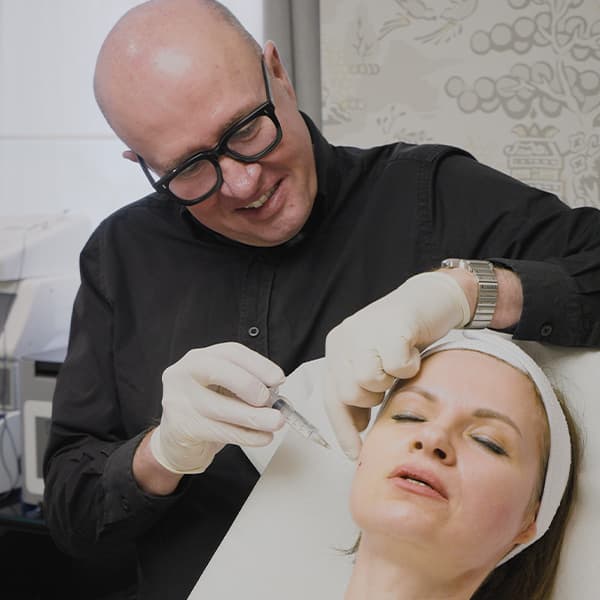
Short clips filmed at Dr Joney De Souza Clinic in Marylebone, so you can see how anti-wrinkle injections is carried out before you book.
If the lines between your brows tell people you are cross when you are only thinking, Dr Joney De Souza or Dr Mattia Parducci can soften them. Phone 020 7043 0748 for an appointment, or ask about frown lines on WhatsApp.
Frown lines raise more questions than almost any other area, from units and timing to how the result looks in photographs. Here are the ones we hear most often in clinic.
They are the vertical creases that appear when the corrugator muscles pull your brows together. The name comes from their shape, two parallel grooves that look like the number eleven. Some people have only one line, others three. They tend to deepen with years of concentrating, squinting at bright light or reading small text.
There is no single number, because the corrugators vary greatly in size and strength from one face to the next. A gentle frowner needs less product than someone whose brows knit tightly together. The dose is chosen after watching you frown. At the review, a little more can be added if one side needs it.
Lines that only show when you frown usually smooth out almost entirely. Grooves that remain at rest soften well and often fade further over several cycles. A very deep etched line also benefits from skin quality treatment, which Dr Joney De Souza or Dr Mattia Parducci plans alongside the injections.
A little, yes, and that is deliberate. The aim at our clinic is to ease the pull, not to switch it off, so you can still show concern or concentration. What changes is that the brows stop knitting tightly together and the skin between them no longer pleats into deep grooves.
Mirrors usually show your face lit from the front, which flattens creases. Cameras often catch light from above or from the side, which casts a shadow inside each groove and makes it look deeper. Flash photography also picks up foundation that has settled into the line during the day.
Book at least two to three weeks ahead. The change starts at day three to five and has settled by around two weeks. That leaves time for a review if one side needs a touch more. Leaving it until the week of the event means the effect is still building on the day.
Because the muscles between the brows are recruited in different combinations. A 2019 study of 200 people found six frown patterns, some dominated by vertical lines and others by creases across the nose or into the forehead. Your pattern decides where the points go, which is why two friends rarely receive the same map.
The method is the same, but men often have larger, stronger corrugator muscles and a heavier brow. That usually means a slightly larger dose to reach the same softening. The doctors also keep the brows flatter and lower in men, because a raised arch looks out of character on many male faces.
Often they do. A single treatment softens the 11s for around three to four months, and lines that have begun to etch into the skin at rest tend to look shallower with each repeat. The corrugator muscles spend less time folding the same crease, so over a year or two the skin between your brows reads smoother.
For the first few hours keep your hands away from the area. Skip strenuous exercise and stay upright rather than lying flat. That simply lets the product settle where it was placed. Make-up can go back on the next morning, and normal skincare, including serums and SPF, carries on as usual from then.
