
Salmon DNA all over your feed, but what happens in the chair? Your first polynucleotides visit at Dr Joney De Souza Clinic in Marylebone, from numbing cream to the glow that follows.
You have seen the words salmon DNA in your feed a dozen times and saved every post, yet you still could not say what happens once you sit down in the chair. A first polynucleotides appointment at Dr Joney De Souza Clinic in Marylebone is where that question gets a calm, clear answer.
| Performed by | Course | Downtime | Your plan |
|---|---|---|---|
| Dr Joney De Souza or Dr Mattia Parducci | Three sessions, two to four weeks apart | Small raised dots settle within a day | Set by the doctor at consultation |
The reassuring part comes first. A 2024 review of nine published studies and 219 patients found not one severe side effect. The mild ones, tenderness and a little swelling at the injection points, had mostly settled within about a week.
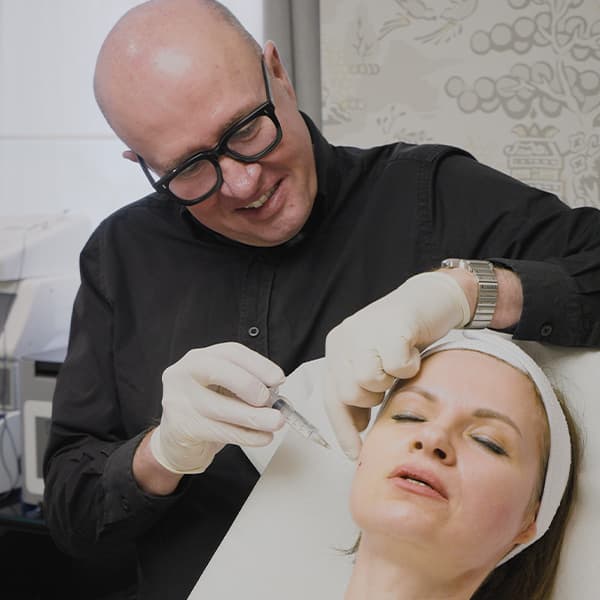
The visit itself is gentle. You arrive, a doctor studies your skin under good light, and a cool numbing cream goes on. Within the hour a series of tiny injections has been placed where your skin has started to thin and crease. You walk out to lunch with a few small bumps that soften by the evening.
Polynucleotides are purified fragments of salmon DNA, refined until they are clean enough to inject. The clinic uses PhilArt, made with a high purification process known as PN-HPT. Because it contains no hyaluronic acid, the treatment adds no volume at all and works on the quality of the skin instead.
The clever part is the message it carries. Fibroblasts, the cells that make collagen and elastin, slow down with age, sun and stress, and polynucleotides hand them a fresh repair signal. They answer by laying down new fibres while the skin holds more water, so the crepe under the eyes and across the cheek looks denser and smoother.
You notice it first in small moments. Concealer sits more evenly in the morning, and a cheekbone catches the light rather than scattering it. Many people describe their skin as springier under the fingertips. That bounce comes from tissue your own cells have built, which is why it looks so natural.
Think of the skin under your eyes at seven in the morning, when it looks faintly papery and the lashes cast a grey shadow onto it. Polynucleotides are designed for that kind of thinning. As the dermis thickens, the skin reflects light more evenly, and the shadow beneath your eyes reads lighter and less tired.

The science is young and growing fast. A 2024 review in the International Journal of Molecular Sciences traces the fragments to chum salmon or trout and credits their popularity to high biocompatibility. Its authors also note that much of the evidence still comes from small studies, which is a fair picture of where the field stands today.
Experienced injectors have filled the gaps with agreed protocols. Eight specialists in dermatology, plastic surgery and aesthetic medicine wrote an Italian consensus report on PN-HPT. It reached recommendations for the face, the eye area, the neck and décolletage, the hands and the scalp. For normal facial skin it set three sessions, 14 or 21 days apart.
That rhythm matches what you will be offered in Marylebone. The skin responds to a series of prompts rather than one large dose, and the gap between visits lets each one settle. What the studies describe as improved texture and hydration is what you see in the mirror as a smoother, brighter surface.
Your first visit runs to about 45 minutes, and most of it is unhurried. Dr Joney De Souza (GMC 7008632) or Dr Mattia Parducci (GMC 7635663) sits with you first and looks at your skin in daylight and under magnification. He asks what you have noticed, from thinning under the eyes to lines that lipstick now feathers into.
Then the numbing cream goes on, a cool and faintly tingling layer that stays in place for around 30 minutes. While it works, your skin is cleansed and the injection points are confirmed. Each point is marked against what Dr Joney or Dr Mattia has just seen in your face, so the map is entirely personal.
The polynucleotides treatment in London covers the face, under-eye, neck, décolletage and the mouth and lower face, and you choose the areas together. One area is enough for many first-timers, and the under-eye is often where people start. Others treat the face and neck in the same visit, because the neck tends to age at the same pace.
Polynucleotides are a prescription-only medicine in the UK, so a doctor takes your history before anything is drawn up. You are asked about your medical history and the medicines you take. Your current skincare and any previous treatments come next, then what you would most like to change in the mirror.
Two questions matter more than the rest. Do you have a fish or salmon allergy, and do you get cold sores? A fish allergy rules the treatment out, and a history of cold sores means an antiviral course may be advised before any injections around the mouth. Both are settled before the numbing cream goes on.
You will also be asked about aspirin, ibuprofen, fish oil and vitamin E. Where it is clinically safe, these are paused for 48 hours beforehand because each one thins the blood slightly, and alcohol is avoided for the 24 hours before. Arrive with clean skin, free of make-up and heavy creams.
Once the cream has done its job, the injecting takes 15 to 20 minutes depending on the number of areas. A very fine needle or a cannula places small amounts into the mid-to-deep dermis. You feel light pressure and the occasional quick scratch, and the numbness from the cream takes the edge off almost all of it.
Each injection leaves a tiny raised bleb on the surface, like a miniature mosquito bite in a neat row. They look far more obvious to you in the mirror than to anyone across a table. The blebs flatten steadily and are usually gone within 24 to 48 hours, along with any faint pinkness.
Most people go straight back to work afterwards. For the first day you keep make-up, retinoids and acids off the treated skin, and for 48 hours you skip hard exercise, saunas, pools and strong sun. Daily SPF protects the new collagen through the course, and that small habit shows in the result.
They look far more obvious to you in the mirror than to anyone across a table.
The first change is hydration, and it arrives early. Within a few days of the first or second session your skin looks fresher and slightly luminous, most clearly across the cheekbones where light lands first. That early glow is water your skin is now holding, and it shows the signal has landed.
The deeper change takes longer, because collagen is built rather than poured in. Between four and eight weeks after each session the texture firms and the crepey look under the eyes softens. Fine lines read shallower in photographs, especially the ones that fan out from the outer corner of the eye when you laugh.
Results last up to six to nine months, with a top-up every six to nine months to keep the repair going. If you are weighing up your options, our guide to polynucleotides compared to skin boosters sets the two side by side. Some plans pair a course with Profhilo for earlier plumpness.
Polynucleotides do not replace lost volume or lift tissue that has dropped. They improve the skin itself, so texture, hydration and thin, crepey patches respond, while a hollow cheek or a deep groove under the eye stays the same shape. Knowing that at the first visit saves months of waiting for a change the treatment was never built to make.
Where volume has gone, the doctors turn to dermal fillers to restore structure on the day, or to Sculptra, which prompts the skin to build its own collagen over two to three months. Polynucleotides often sit alongside either one, refining the skin that lies over the new support.
Every injection here is given by a doctor. Dr Joney De Souza is the founder and Medical Director, and he and Dr Mattia Parducci both treat with polynucleotides, reading the thickness and texture of your skin as it moves.
The clinic sits on Blandford Street in Marylebone, close to Harley Street and a short walk from Baker Street station, so a first visit fits easily around a working day in central London. It holds a 4.9 Google rating from more than 270 reviews, and people return because their skin still looks like theirs.
Your first appointment is the consultation and, when it suits your skin, the first treatment on the same day. Most people have a course of three sessions spaced two to four weeks apart, with a fourth for more advanced concerns, though the consultation gives the real answer. Your plan, dates and investment are written down for you before you leave.
If you have been circling this treatment for months, come and let Dr Joney De Souza or Dr Mattia Parducci show you what your skin is ready for. Read more on our polynucleotides page, then choose a time that suits your week.
Short clips filmed at Dr Joney De Souza Clinic in Marylebone, so you can see how polynucleotides is carried out before you book.
Come and meet Dr Joney De Souza or Dr Mattia Parducci, who will look closely at your skin and plan the areas with you before a single injection. Ring us on 020 7043 0748, or send us a message on WhatsApp.
These are the questions people ask most often before their first polynucleotides session in Marylebone, from the salmon DNA itself to how soon the bumps disappear. Any figure quoted below carries a link to its source.
Yes, they are. The fragments are purified salmon DNA, cleaned to a medical grade before they ever reach a syringe. The fish is only the source. Once injected, the fragments act as a repair signal for your fibroblasts. The collagen and elastin that follow are built by your own cells, so the result is entirely yours.
Allow about 45 minutes in total for the visit. Roughly half an hour is the numbing cream settling while your skin is cleansed and the points are marked. The injecting itself takes 15 to 20 minutes, depending on how many areas you treat. After that you are free to head back to your day.
They often soften within a few hours and are usually gone within 24 to 48 hours. Each small bleb is simply product resting in the skin before it spreads out. An afternoon slot means most of the flattening happens while you sleep. You then wake to skin that looks close to normal.
Leave make-up off the treated area for 24 hours. The tiny entry points need that time to close, and clean skin gives them a calm start. Mineral SPF can go back on the following morning. From then on, daily sun protection helps the new collagen settle through the rest of your course.
In most cases it is, which saves you a second trip. Once Dr Joney De Souza or Dr Mattia Parducci has examined your skin and agreed the areas, treatment usually follows straight away. If he feels another approach would suit your skin better, he will tell you there and then.
The published record so far is reassuring. A 2024 systematic review of nine studies found no severe adverse events, and the mild ones, such as pain or swelling at the injection points, mostly resolved within a week. A fish or salmon allergy is the main reason a doctor would say no.
A fresher, more hydrated look often appears within days of the first or second session. The firmer texture comes between four and eight weeks, as new collagen builds in the dermis. Photographs from your first visit help you see the change clearly. Gradual improvement is surprisingly easy to miss in your own mirror.
A flight a day or two later is usually fine. The small injection bumps settle within hours, and any pinpoint bruising is easy to cover once the first day has passed. Cabin air is very dry, so carry a rich moisturiser and drink plenty of water. Long-haul trips are best booked a few days after a session rather than the same evening.
Keep to gentle walking for 48 hours after your session. Hard workouts, hot yoga, saunas and pools all raise heat and blood flow in the skin. That can keep the injection points puffier for longer. After two days you can return to your usual routine, and the treated skin will be quite happy.
No, and that is a large part of their appeal. They contain no hyaluronic acid and add no volume, so your features stay where they are. The skin itself grows thicker, smoother and better hydrated. Friends tend to say you look rested rather than noticing anything specific.
