
You read about PRP for thinning hair, then saw PRF in the same breath. See why the slower spin matters at your scalp, and how a PRF hair course runs at Dr Joney De Souza Clinic in Marylebone.
You have read about PRP for thinning hair, booked nothing yet, and then seen PRF mentioned in the same breath. Your parting still shows more scalp than it used to, and now there are two sets of initials to choose between. That one extra letter matters more than it looks, and it is why the doctors often choose PRF hair treatment at Dr Joney De Souza Clinic in Marylebone.
| Performed by | Course | Downtime | Your plan |
|---|---|---|---|
| Dr Joney De Souza or Dr Mattia Parducci | PRF two sessions, six to eight weeks apart | Mild swelling for a day or two | Set by the doctor at consultation |
Women given injectable PRF for pattern thinning saw their hair count rise by 26.5 percent at 24 weeks in a 2026 randomised trial, while the group given PRP rose by 14.5 percent. Same blood, same scalp, a different spin, and nearly twice the gain.
Both treatments start with your own blood, drawn from the arm on the day. Both return a concentrate of platelets to the follicles that have started to thin. Dr Joney De Souza (GMC 7008632) or Dr Mattia Parducci (GMC 7635663) performs both, choosing scalp by scalp.
Picture the PRP tube first. It spins at high speed for about ten minutes and comes out cleanly divided. Dark red cells sit below and a clear, straw-coloured plasma rests above. The platelets in that plasma sit at three to five times their usual concentration, ready to release their growth factors almost at once.
The PRF tube is handled differently from the start. It contains no anticoagulant and no synthetic additives, only your blood. The centrifuge turns more slowly, so the platelets and white blood cells stay woven into a soft fibrin matrix. What you see in the tube is a golden layer with a delicate, slightly gelled quality.
That fibrin is the same protein your body lays down whenever skin repairs a small graze. In the scalp it behaves like a gentle scaffold that holds the platelets around each follicle. Their growth factors then seep out over days and weeks rather than in a single burst.
The laboratory work backs this up. Researchers at the University of Bern measured growth factor release from both preparations over ten days, in a 2016 study in Clinical Oral Investigations. PRP released significantly more in the first hour, while PRF kept up a continual, steady release across the full ten days.

The 2026 trial ran across several hospital centres. Women with moderate female pattern hair loss were randomised to PRP, injectable PRF or a third platelet concentrate. Each had four sessions four weeks apart, and 74 completed the study. Hair counts rose in every group, while the PRF group gained significantly more than the PRP group.
Strand thickness improved in all three groups to a similar degree, and the PRF group reported the fewest side effects of the three. The researchers also tracked VEGF, a growth factor that feeds the small blood vessels around each follicle. Higher levels of it went hand in hand with a bigger rise in hair count.
A 2024 review in the Journal of Cosmetic Dermatology puts that result in context. Five clinical studies of PRF for pattern hair loss all showed a significant effect. There is still no agreed recipe for the spin, and the authors call for larger trials that set PRF directly against PRP. PRF is promising and still being refined, so your plan rests on your scalp rather than on one study.
Hair grows slowly, and a follicle coming out of its resting phase does not wake in an afternoon. A signal that lingers suits that pace well. With PRF, the follicles around the parting and crown keep receiving growth factors long after you have left the clinic and gone back to your week.
The white blood cells held inside the fibrin add something too, because they are part of the body’s own repair team. Keeping them in the mix gives the scalp a fuller version of its natural healing response. The plasma works more like a slow-release dressing than a single dose.
For many people with diffuse thinning, where the whole scalp has lost density rather than one patch, that steady signal is a natural match. The hair across the top starts to feel thicker between your fingers. The scalp shows less under a strong overhead light, and the shower drain gathers fewer strands each morning.
Think about how the scalp looks at week eight of a PRF course. The parting is still yours, but the skin along it shows less. Fine new hairs stand up at the front, shorter than the rest and soft to the touch. Under a bathroom spotlight, the crown no longer catches the glare it did in spring.
The scalp shows less under a strong overhead light, and the shower drain gathers fewer strands each morning.
Shedding tends to calm first, with meaningful change visible from four to six weeks. Density then builds over two to six months. You notice it in small moments, a ponytail that needs one fewer twist of the band or a parting that sits closed when you tie your hair back.
PRP still has a firm place in hair restoration. Its fast, concentrated burst of growth factors is a strong opening signal for follicles that are thinning quickly. The clinic’s dedicated PRP hair loss treatment is built around that faster spin and a careful grid of injections across the thinning areas.
PRF comes into its own where a gentler, longer conversation with the follicles makes more sense. It suits a scalp that responds well to steady encouragement. It also appeals to anyone who likes the idea of a preparation with nothing added at all. Either way, nothing goes into your scalp except what your own blood provides.
PRF carries growth factors only, and it does not bring the purified DNA fragments that support the scalp tissue itself. That is the job of polynucleotides for hair, which Dr Joney De Souza injects over two to three sessions. Where thinning has several causes at once, the two sit together in one plan.
The blood draw comes first, from a vein in the arm, and it feels much like a routine blood test. A few minutes later your sample is already turning gently in the centrifuge. You sit back with the cream on your scalp and very little to do but wait.
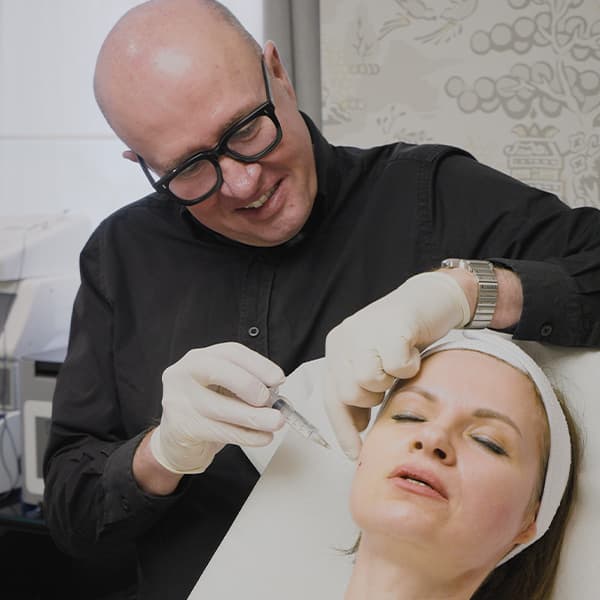
The whole appointment takes about an hour, including the blood draw and numbing. A topical numbing cream goes onto the scalp where needed and takes around 20 minutes to work. Meanwhile the gentle spin is under way and your fibrin-rich plasma is being prepared.
The injections themselves take 15 to 20 minutes. The doctor works across the thinning areas with fine, shallow placements. You feel a series of light pressures through the numbness, strongest at the crown where the skin sits close to the bone.
Afterwards the scalp feels warm and slightly tender. Small bumps or a little redness at the injection points are normal and settle within a day or two. Skip strenuous exercise for 24 hours and give saunas and other heat a miss for 48 hours, so the fibrin can do its slow work undisturbed.
Your first visit is with Dr Joney De Souza or Dr Mattia Parducci, and it starts with your hair history. When did you first see more scalp along the parting, and has the shedding come in waves or crept in steadily? A sudden fall after illness or childbirth points one way, and years of gradual thinning points another.
You are asked which medicines and supplements you take. Aspirin and fish oil thin the blood, so they are usually paused for a few days where that is safe. You are also asked what you already use on your scalp at home, and whether PRP has been tried before.
The doctor then parts your hair in several lines and studies each strand as well as the skin of the scalp. Fine, wispy strands tell a different story from strong hair that is simply sparse, and that difference often decides between the two spins.
A typical PRF course is two sessions spaced six to eight weeks apart, though the consultation gives the real answer for your scalp. Results keep improving for around six months, and the course and its investment are set out before your first session. The clinic’s overview of PRP and PRF shows the other areas the same plasma treats, from the face to the neck.
The clinic is in Marylebone, a few minutes on foot from Bond Street and an easy hop from Regent’s Park or anywhere in central London. Its 4.9 Google rating comes from more than 270 reviews. You can read about Dr Mattia Parducci before you arrive.
If you have been weighing up the two spins, come in and let a doctor look at your scalp and tell you which one fits. Book PRF hair treatment at the clinic and leave the first appointment with a clear plan for your hair.
Short clips filmed at Dr Joney De Souza Clinic in Marylebone, so you can see how prp and prf is carried out before you book.
Not sure whether PRF or PRP suits your thinning? Dr Joney De Souza or Dr Mattia Parducci will look at your scalp and recommend the spin that fits. Phone 020 7043 0748 or chat with the clinic on WhatsApp to book.
These are the questions people bring when they are deciding between the two plasma treatments for thinning hair, from the tubes themselves to the shedding phase.
In one 2026 randomised trial of women with pattern thinning, PRF raised hair count by 26.5 percent against 14.5 percent for PRP. That is one trial, and neither plasma wins for every woman. PRF suits diffuse thinning across the top of the head, while PRP gives a fast signal for quicker shedding. Some women benefit from both at different stages.
An anticoagulant stops blood from clotting, which is useful for PRP but would break up the fibrin that makes PRF special. Leaving it out lets your blood keep its natural fibrin net. That net holds platelets and white blood cells together, so the finished plasma is purely yours with nothing synthetic added along the way.
Yes, and it sometimes makes good sense. Say your scalp has responded well to the faster PRP signal and now needs steady support. The doctors can then move you onto PRF for the remaining sessions. The blood draw and the injections feel almost identical, so the change is barely noticeable from your side of the chair.
Very rarely anything that shows. A little redness or a few small bumps at the injection points are normal and fade within 24 to 48 hours. Your hair falls back over the treated area, so most people head out afterwards without anyone noticing. A soft hat or a loose style feels comfortable that first evening.
Results keep building for around six months after the course, and the hair continues to benefit beyond that. Like any treatment working with living follicles, the effect softens gradually over time. Maintenance sessions keep density steady, and the doctors suggest a rhythm once they have seen how your scalp responded to the first round.
Yes. A small sample is drawn from your arm on the day, then spun gently with nothing added, so it settles into the fibrin-rich layer that goes back into the scalp. The whole preparation happens in the clinic while you wait, which keeps the plasma fresh, and Dr Joney De Souza or Dr Mattia Parducci then treats the thinning areas.
It can, when the follicles along the temples are still active and producing fine hair. The fibrin holds growth factors close to the hairline, which is useful in an area where hair has thinned gradually over years. Early action matters, so a hairline that is softening rather than completely smooth responds far better.
Where it is safe to do so, pause aspirin and fish oil for a few days beforehand. Both thin the blood a little. Healthy platelets give the strongest fibrin. If you take anything prescribed, tell the team when you book and the doctors will advise you on what to continue.
A little extra shedding in the early weeks is a normal part of the cycle, because weaker strands make way for stronger growth beneath them. It settles on its own. From four to six weeks most people notice the brush collecting less, and the new growth that follows is thicker and more robust.
Yes, the two pair naturally. PRF supplies your own growth factors in a slow-release fibrin scaffold, while polynucleotides support the scalp’s repair with purified DNA fragments. Read more about polynucleotides for hair, then ask at your appointment whether a combined plan suits your thinning.
